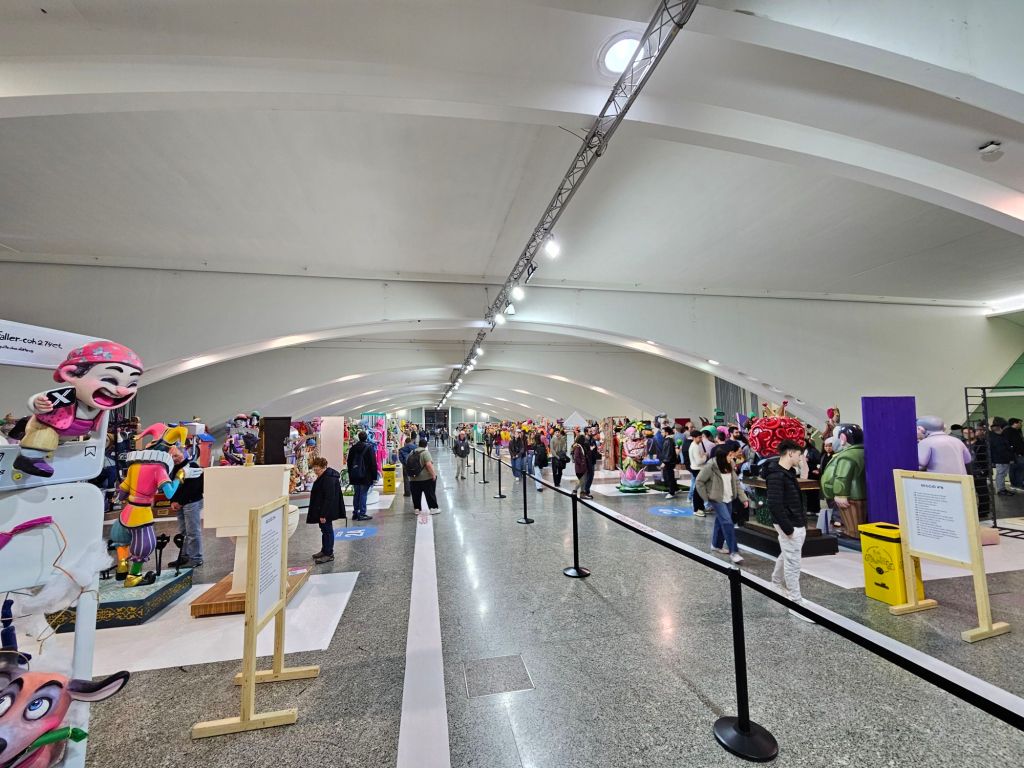
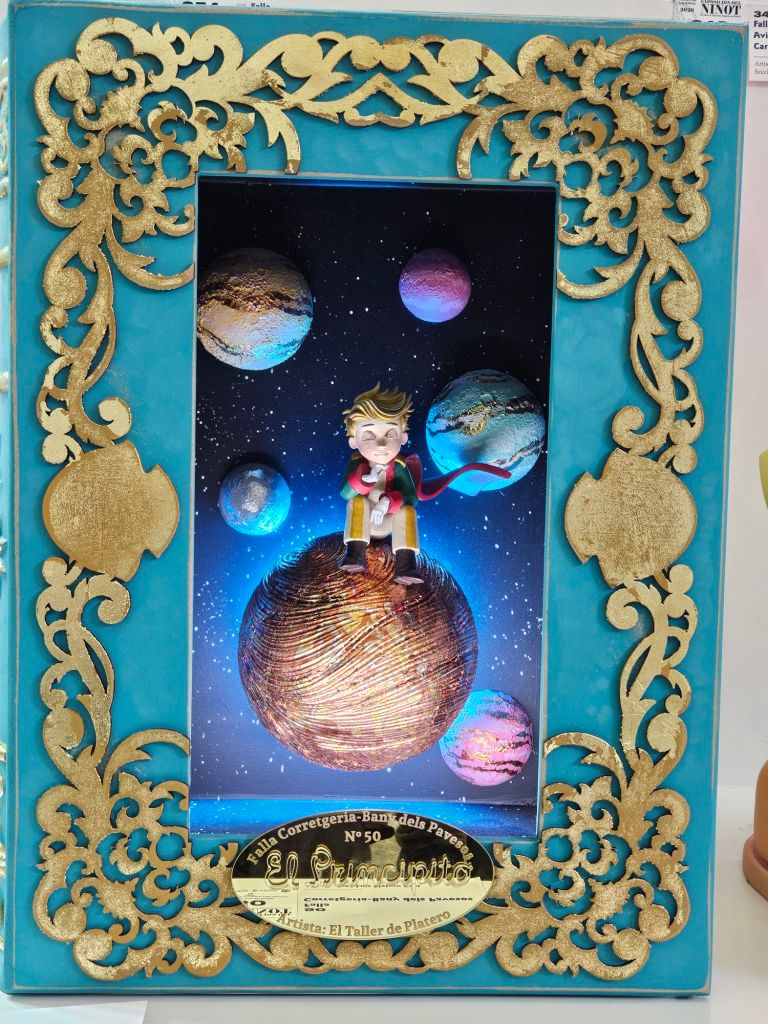
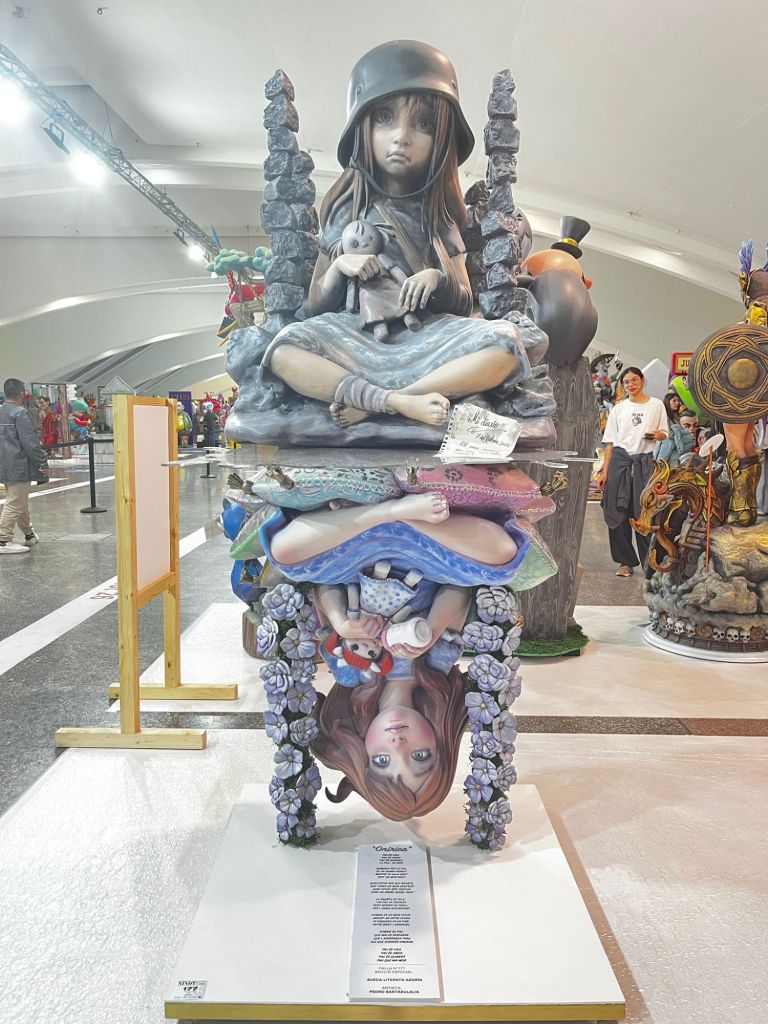
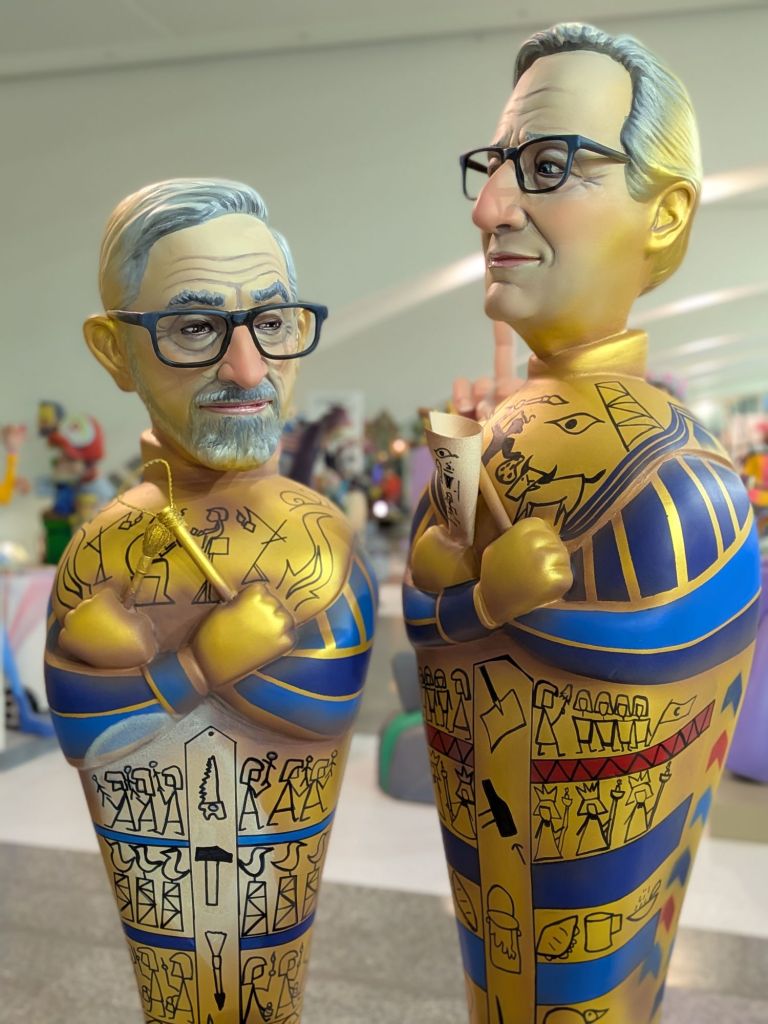
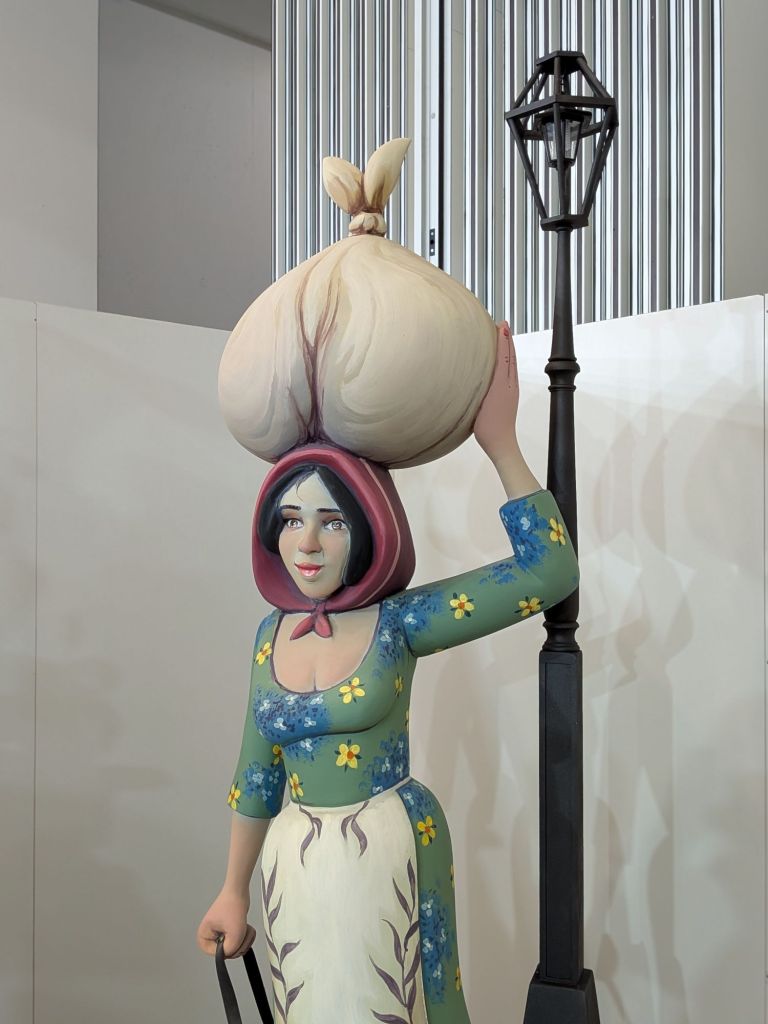
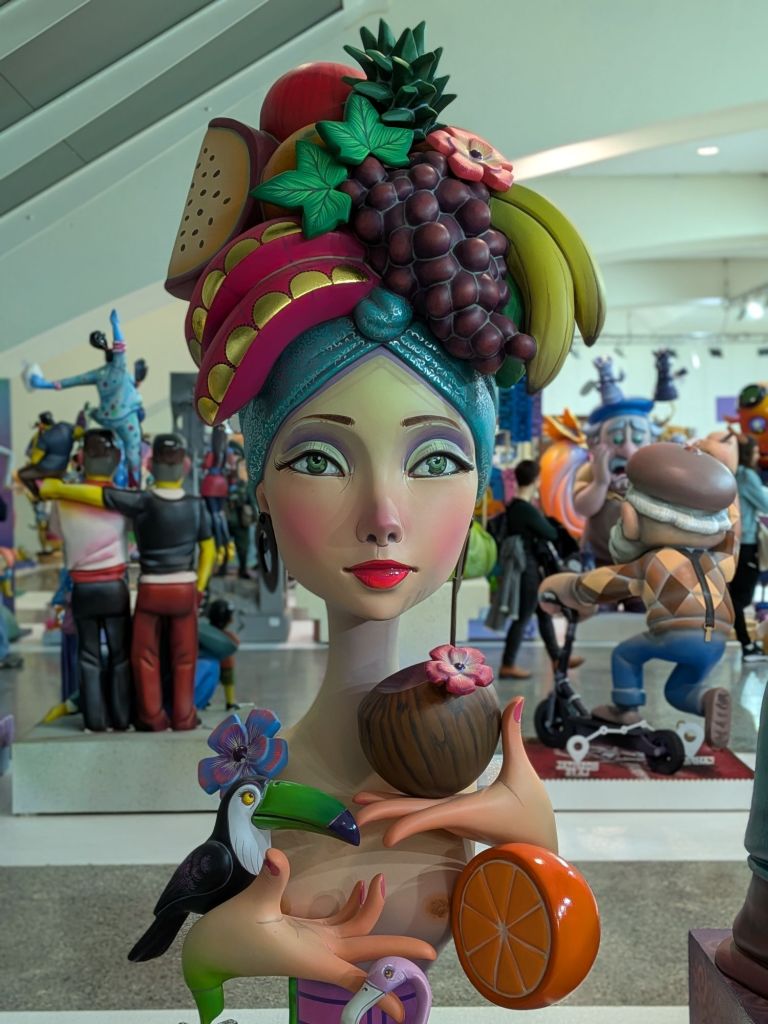
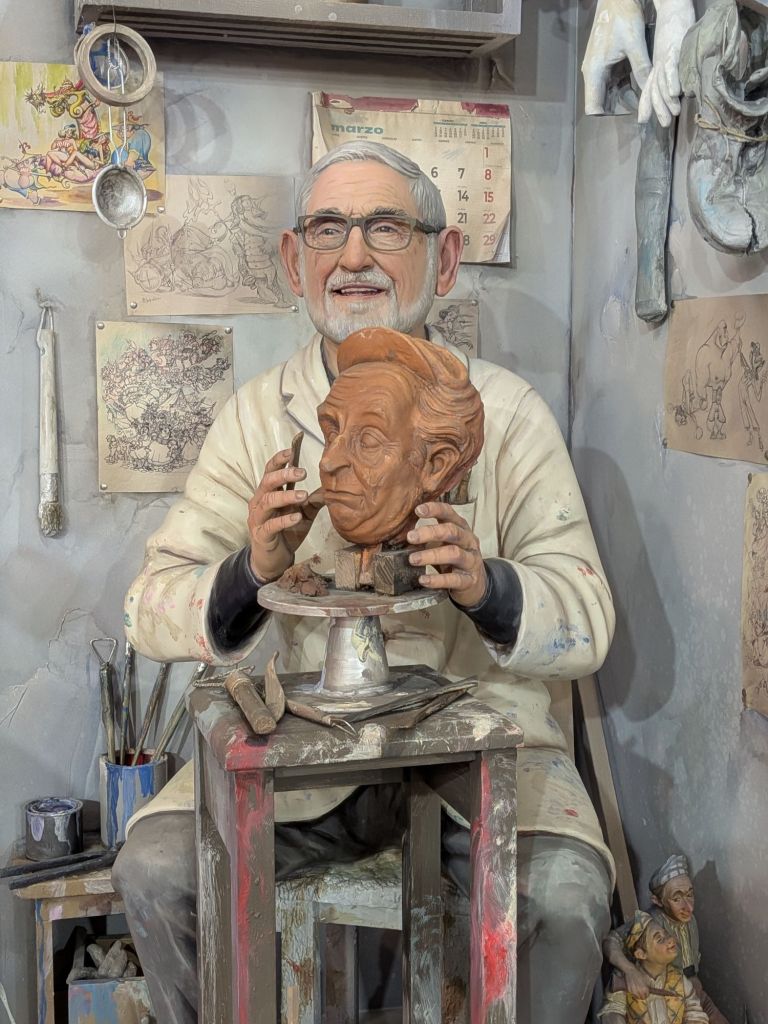
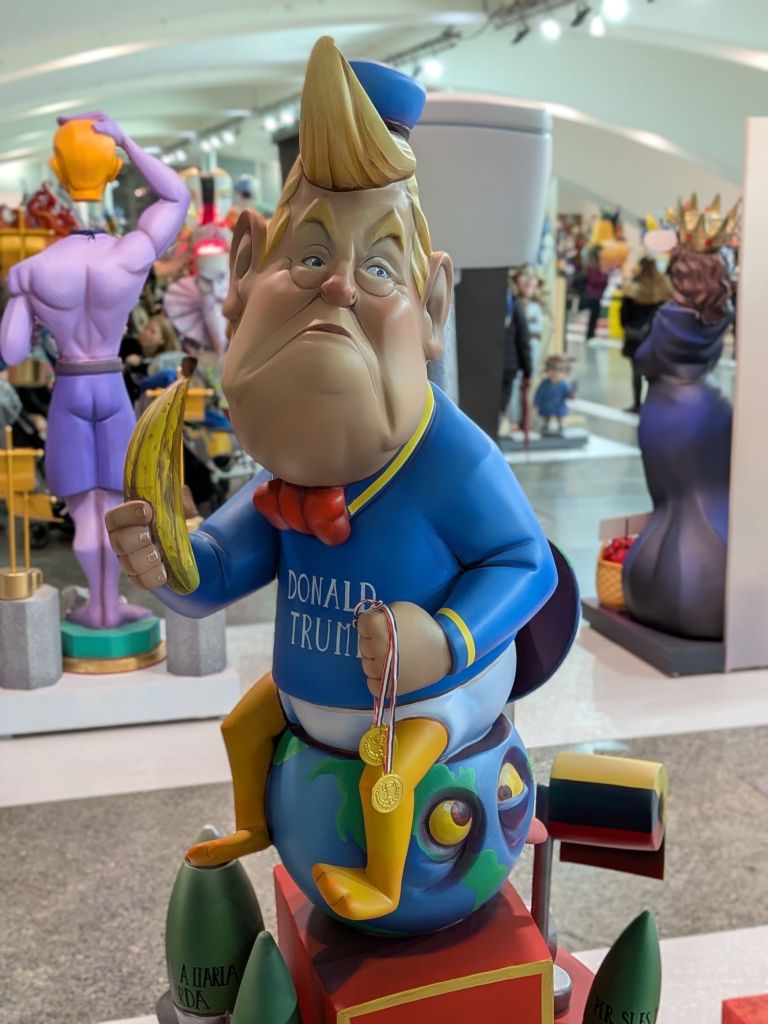
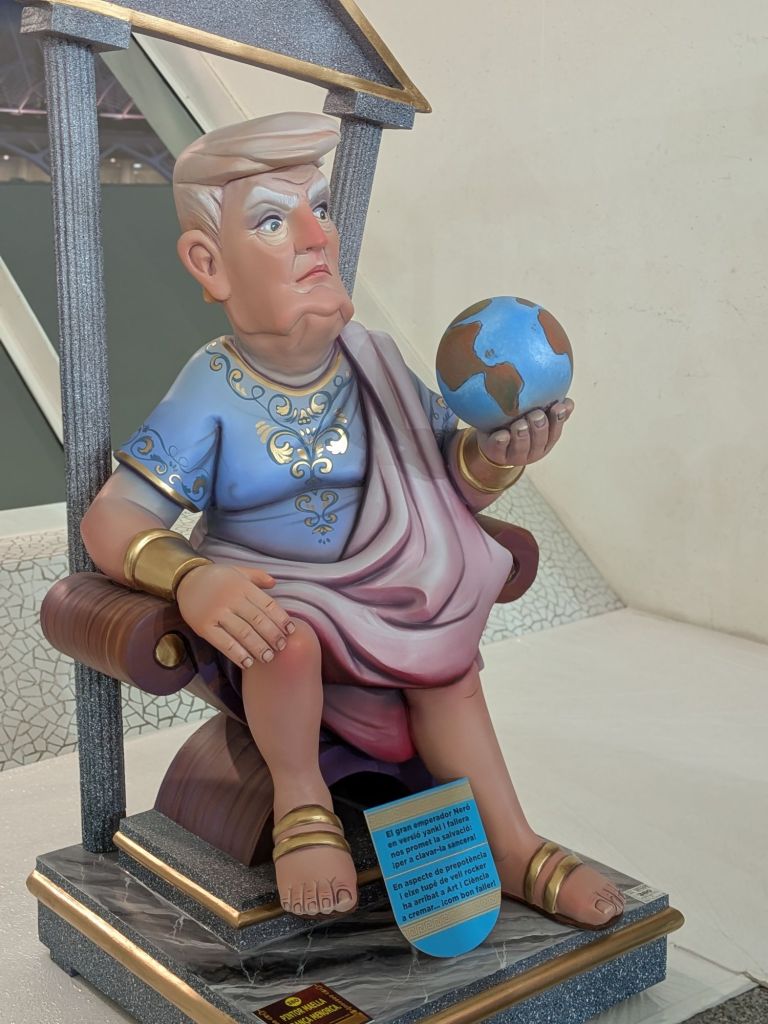
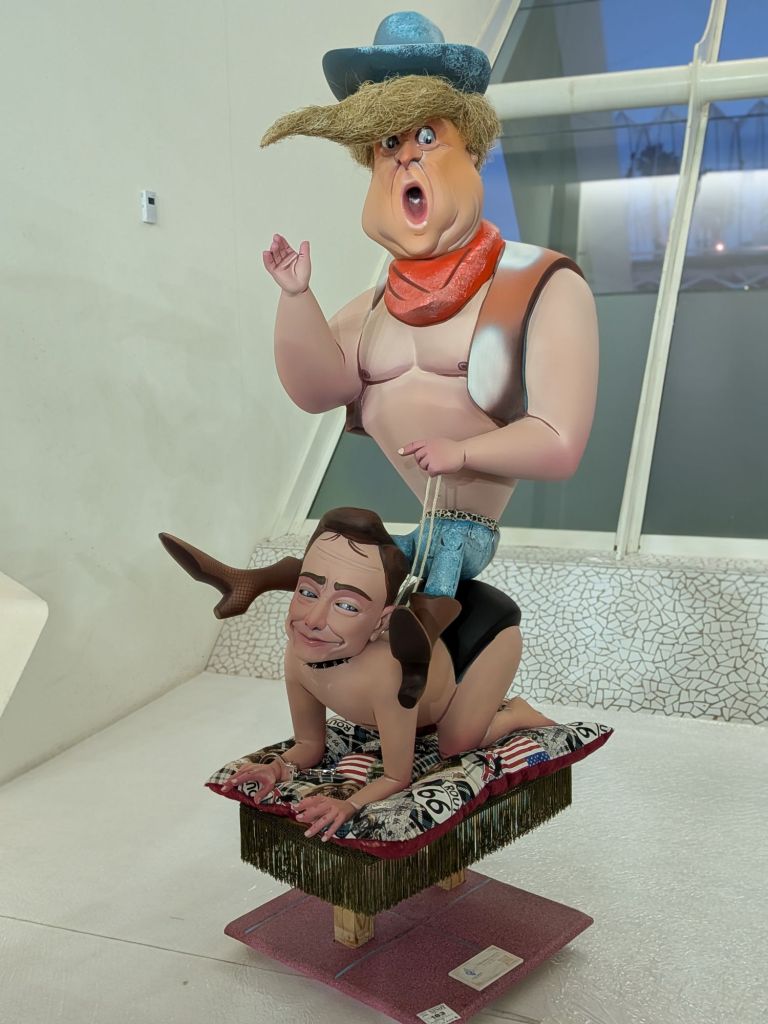
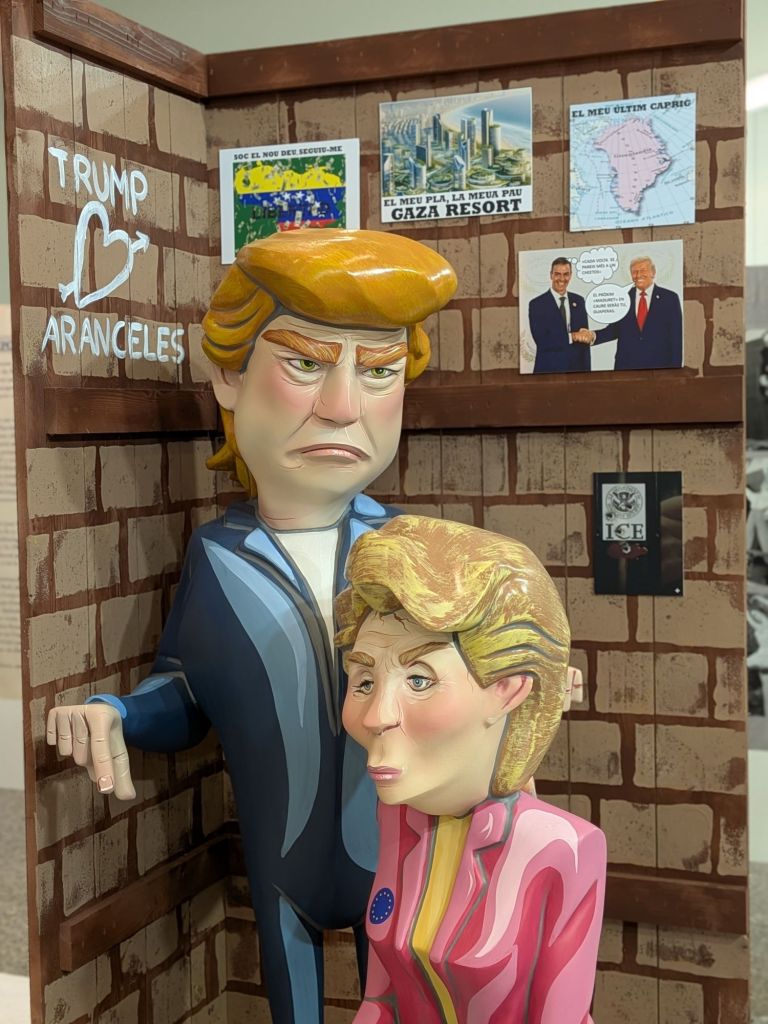
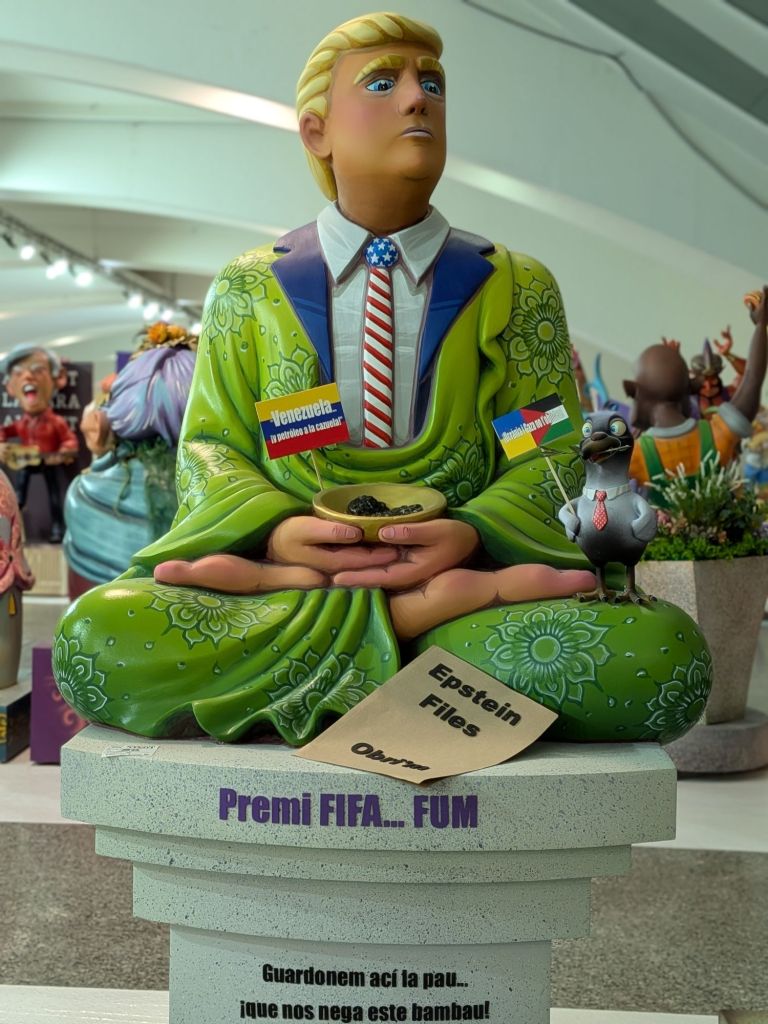
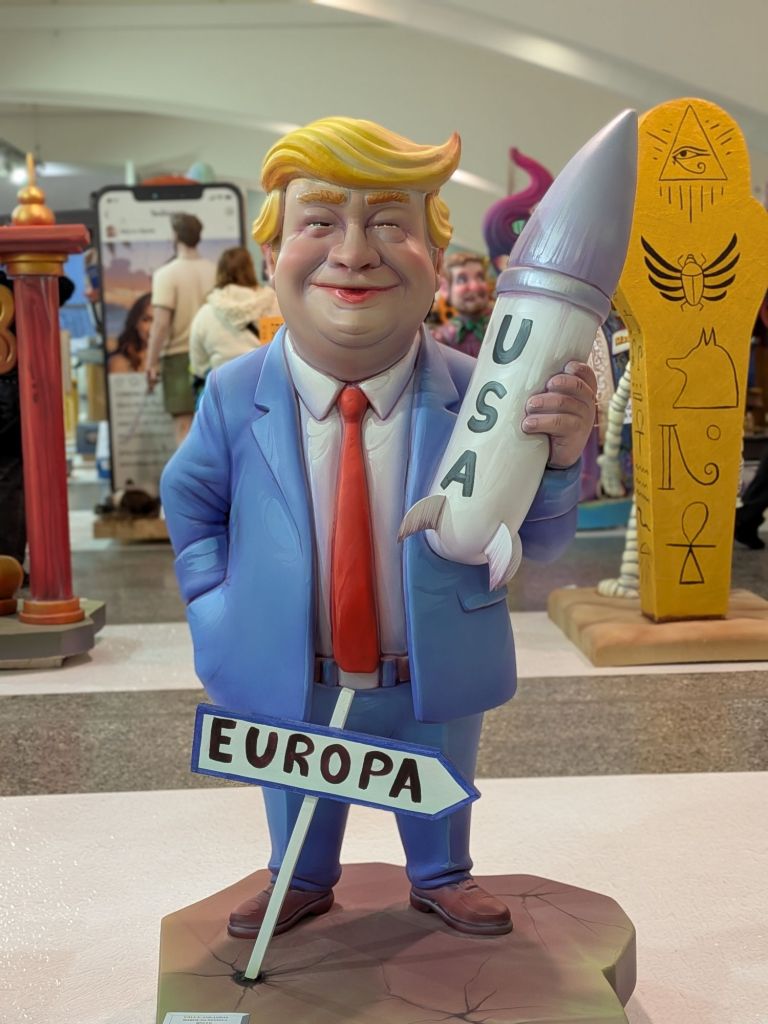
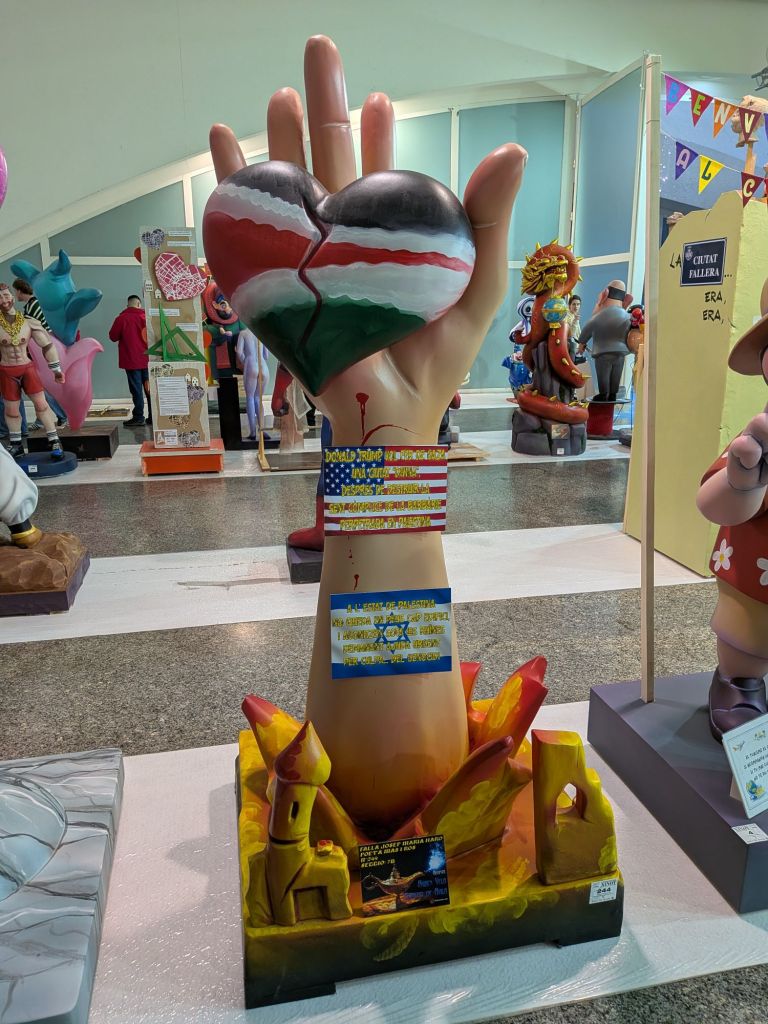
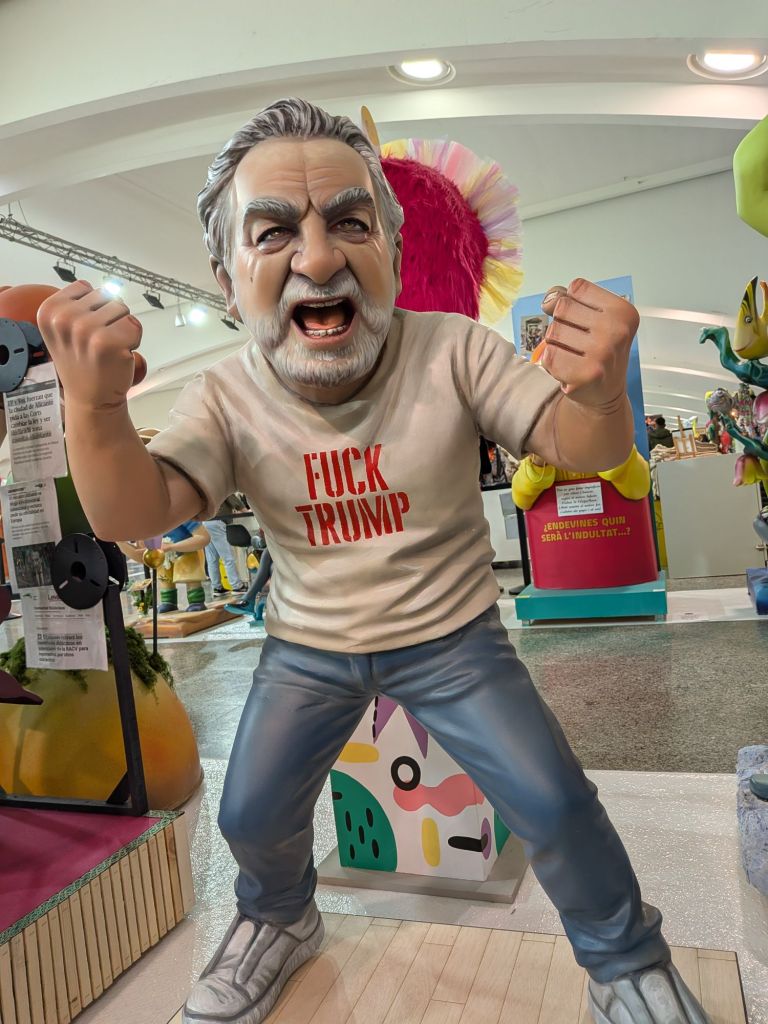
One of the defining features of Las Fallas are the ninots– dolls– constructed by different neighborhoods and groups. They’re currently on display in an exhibition, but they will be installed in the streets soon. Two will be chosen to be saved, and all the rest will be burned (in the streets) at the conclusion of the festival.
Since we’d been to the museum to see the previously saved ones, we thought we ought to go to the exhibition and see this year’s offerings. Bottom line–I find most of them creepy in a Disney meets horror movie clown kinda way, and I don’t understand most of the messaging. But for the record, a few photos.
One theme is especially popular this year:
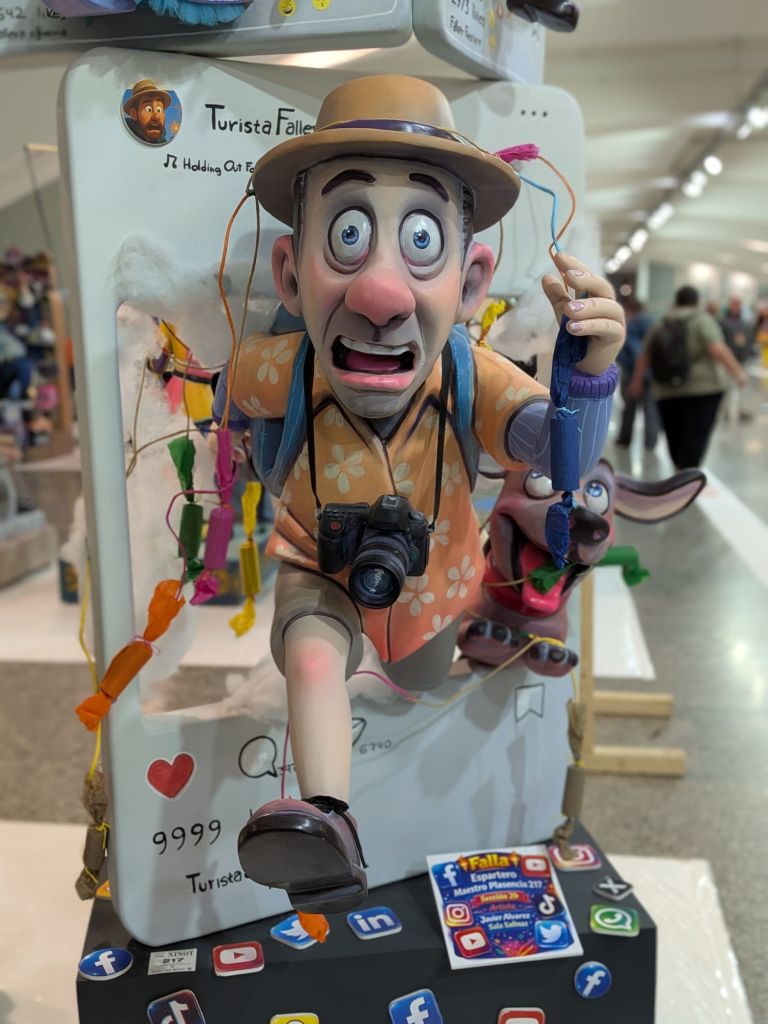
R here. I particularly like this one of a crazed tourist bursting out of a social media post:
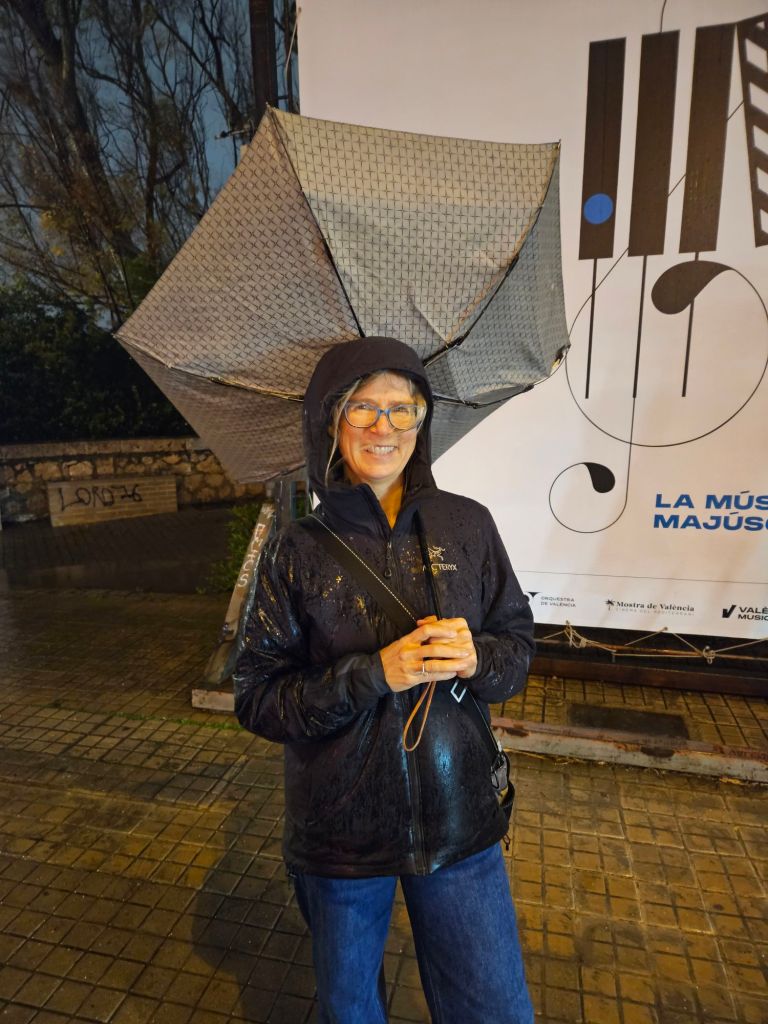
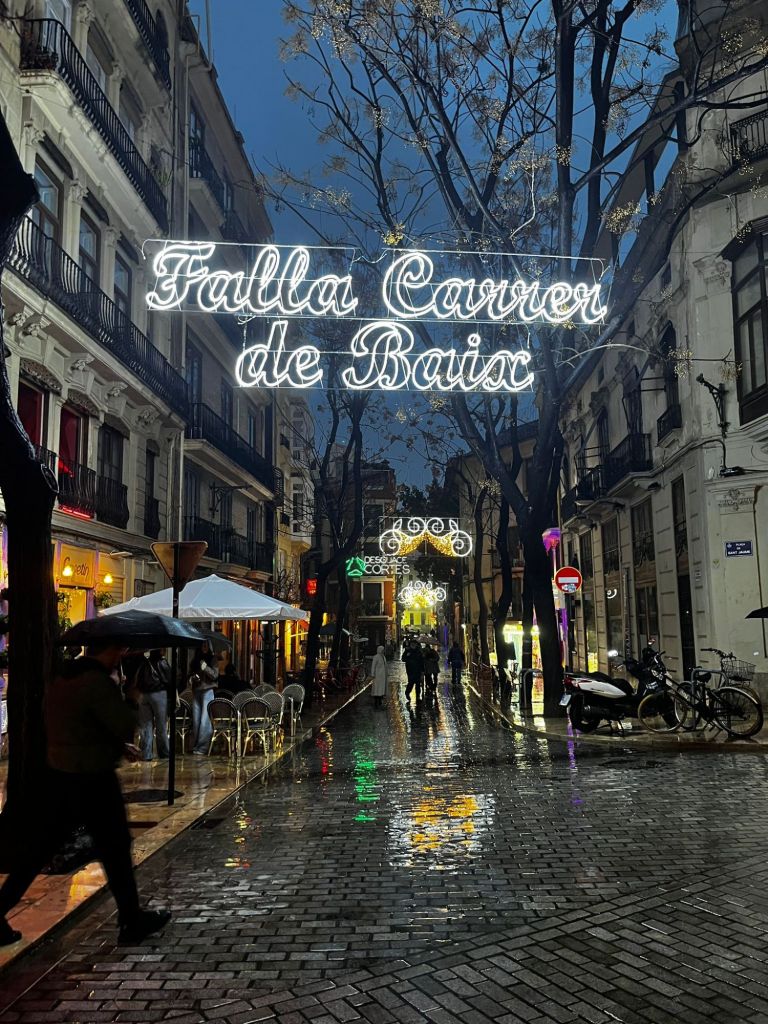
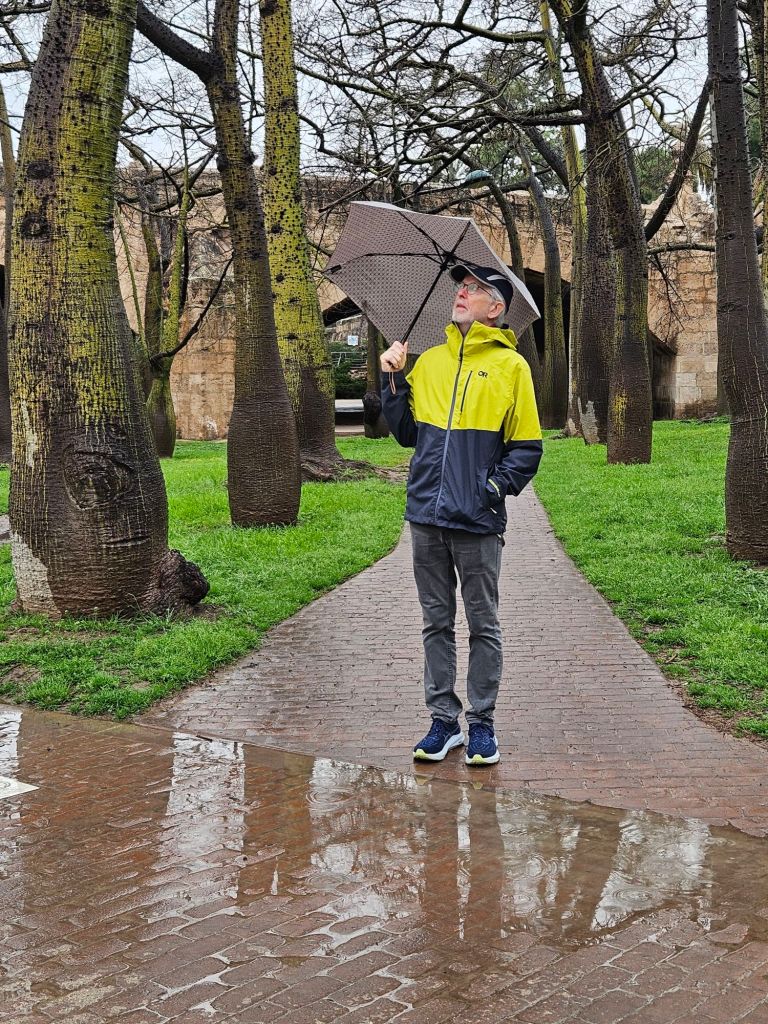
Oh, and we got soaked walking home, but the rain made the streets shine with the Fallas lights.
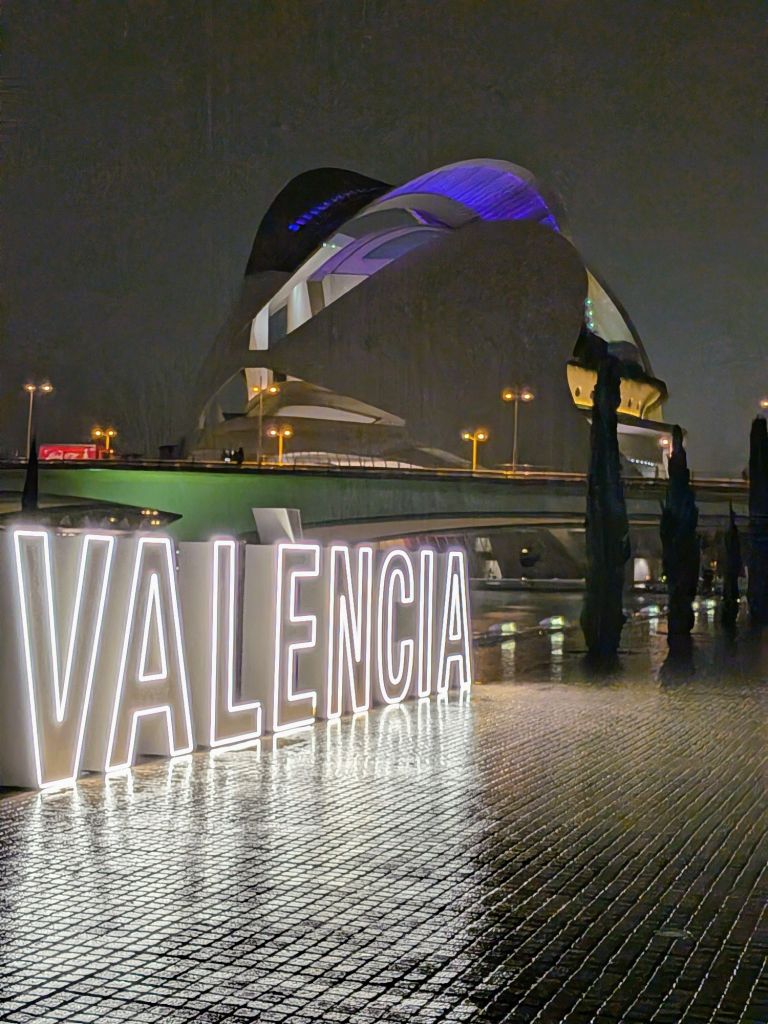
This, btw, is the opera house – in the form of a space aged Conquistador’s hat – that forms the centerpiece of the vast Cuitat des Artes y Ciencias complex, by controversial rock star architect Santiago Calatrava. Looks amazing; 3x over budget; everything leaks.
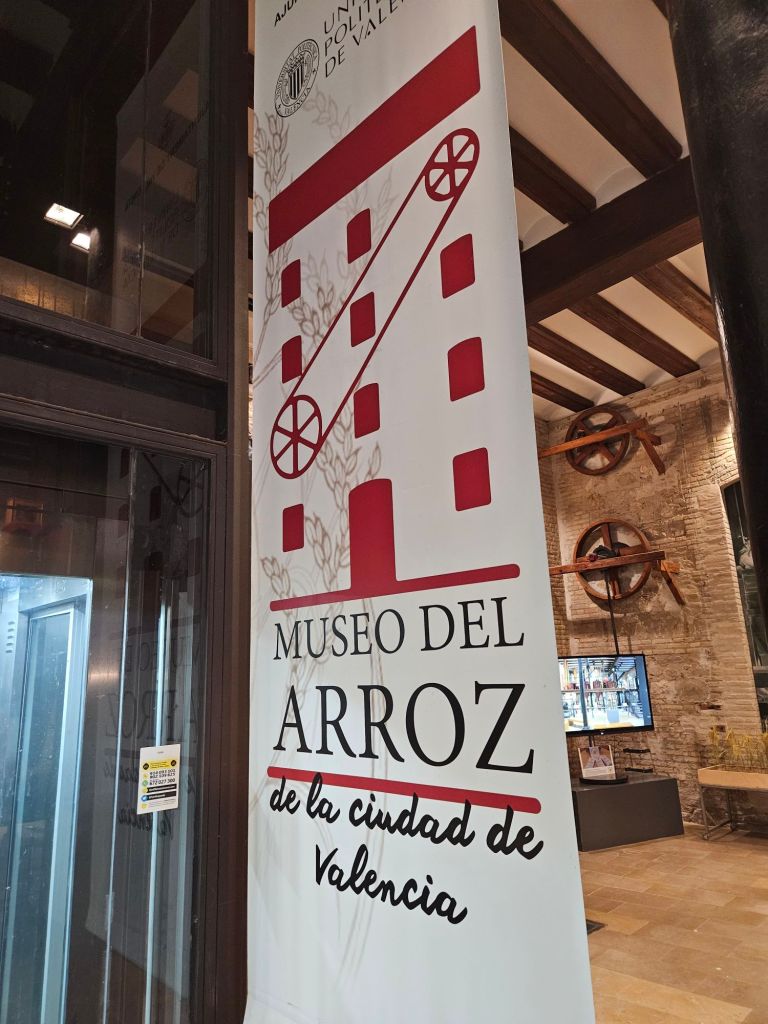
Where do you go when you can’t process any more glorious Renaissance art? The Rice Museum.
Rice, as the exhibits noted, originated in China, but was introduced to Spain by the Moors, who planted it near Valencia in the 8th century. Since then it has become an absolutely integral part of life here, giving rise to the well known Valenciano Paella and many less well known arrozes, both wet and dry.
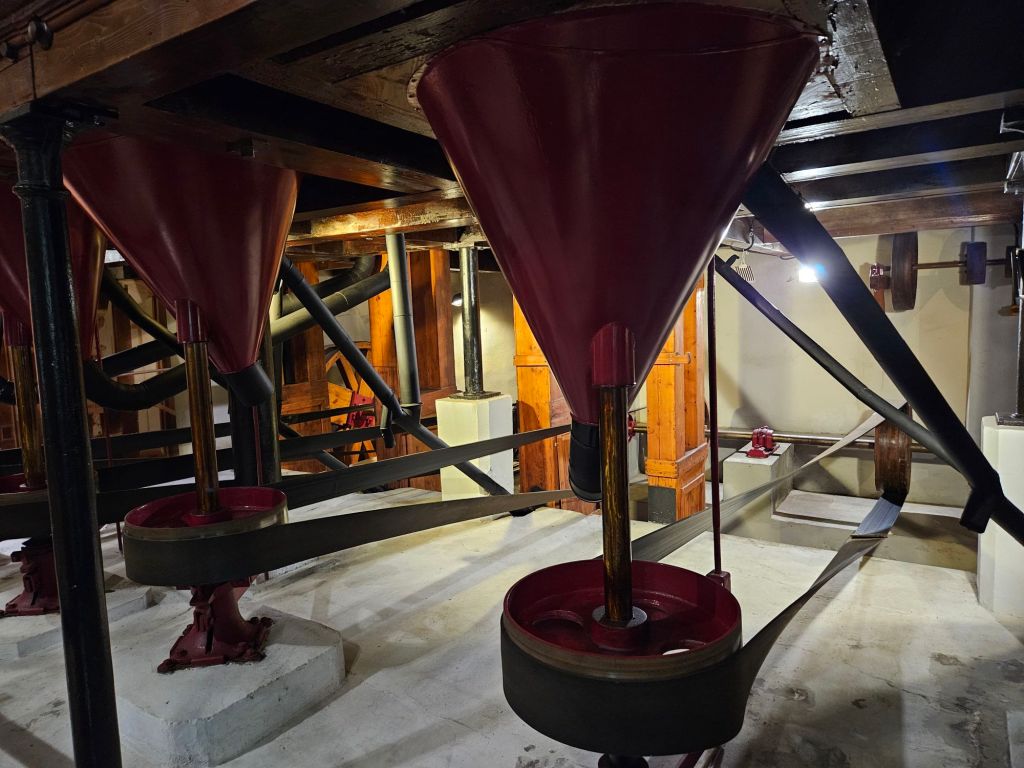
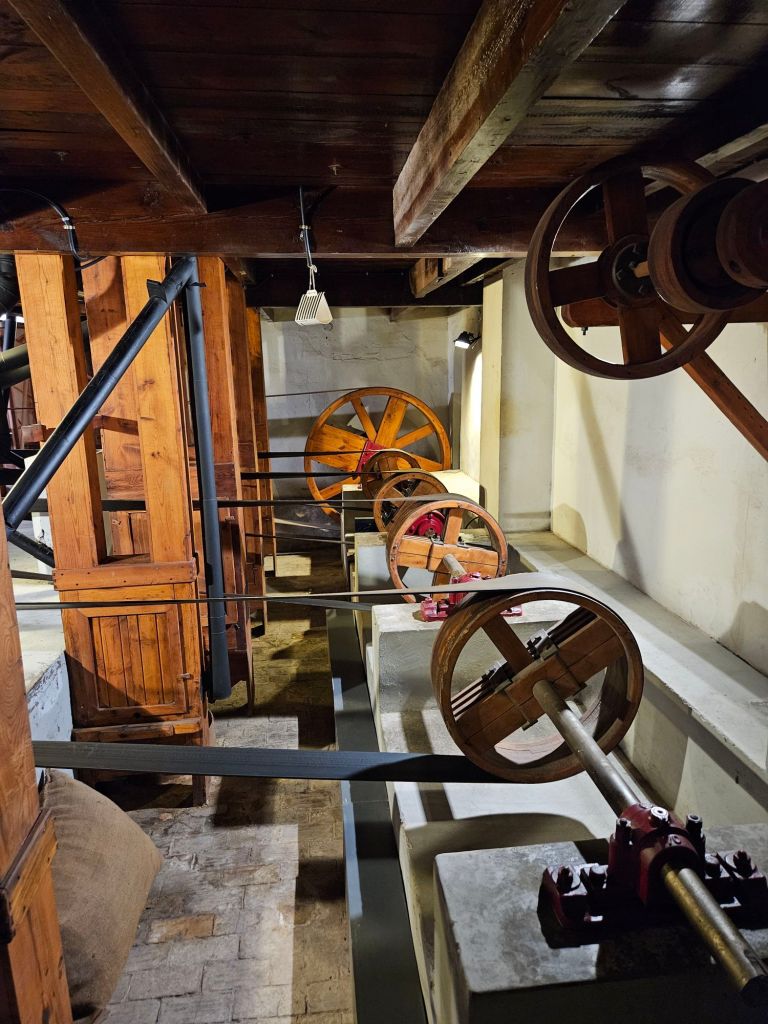
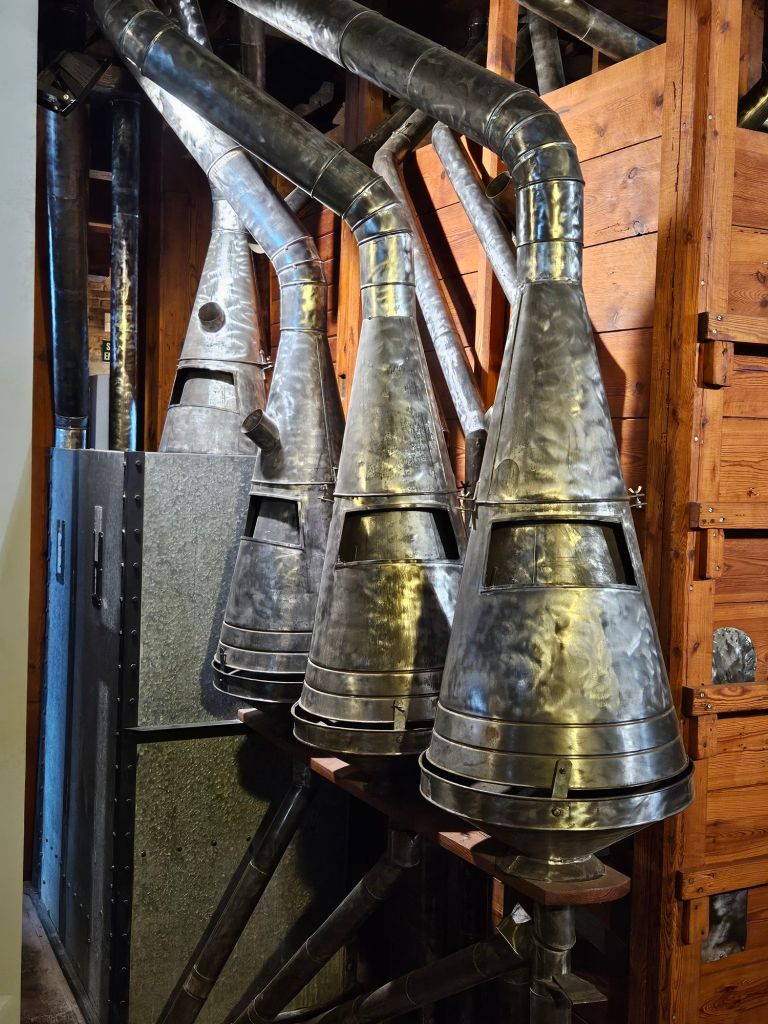
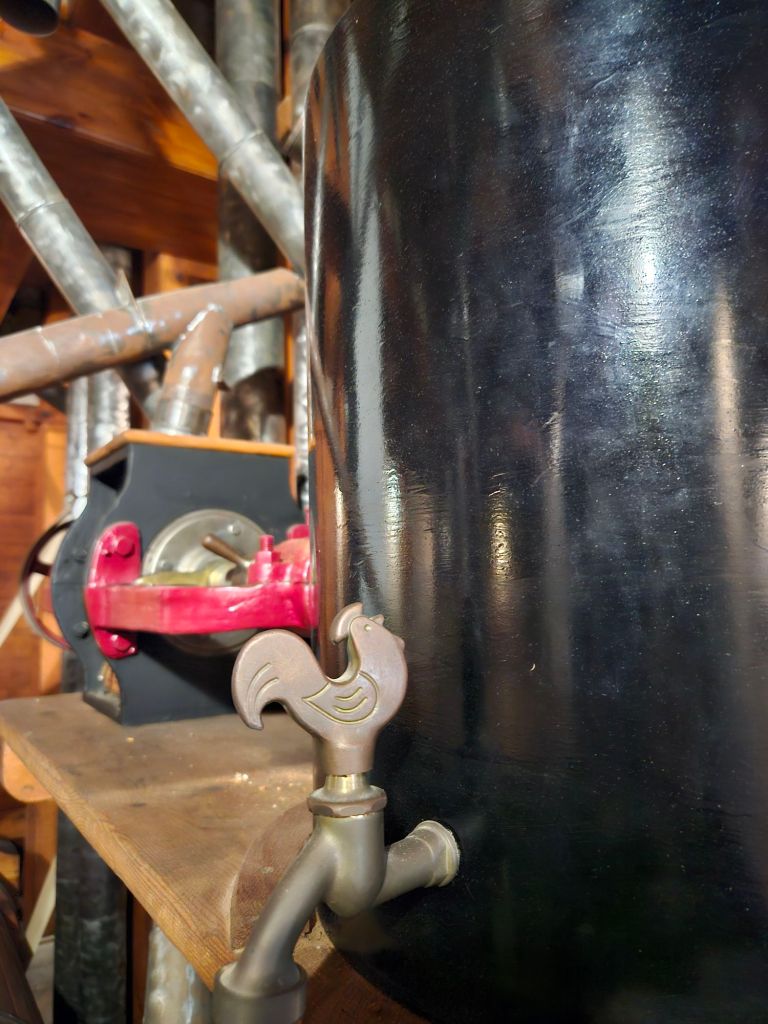
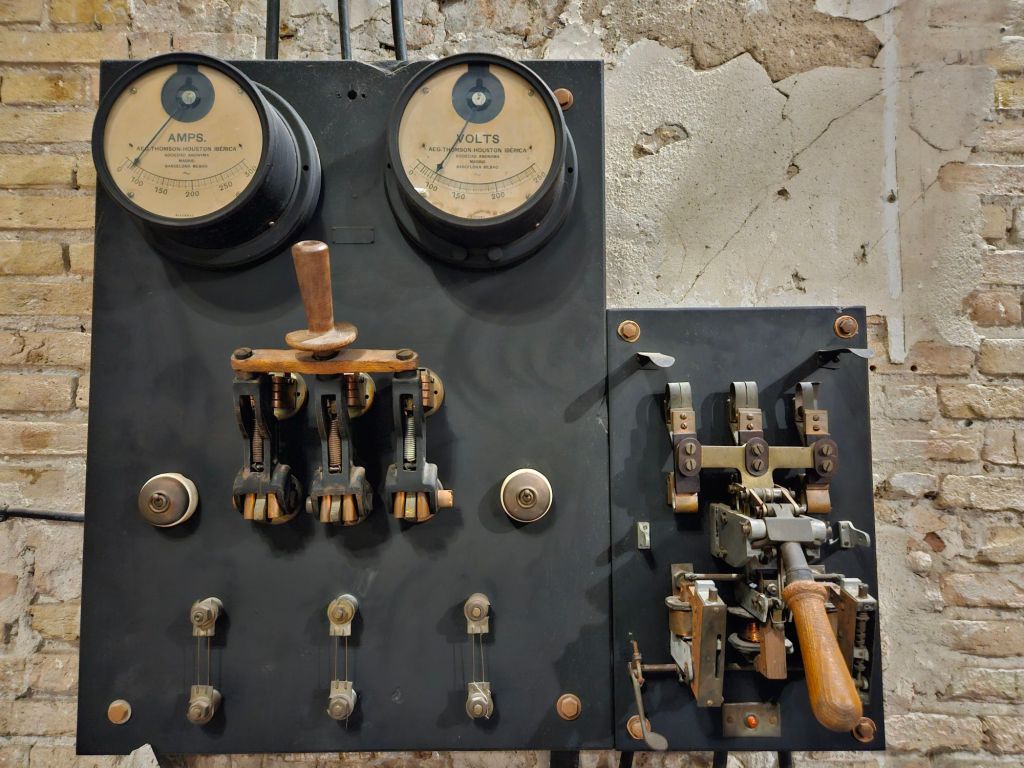
The museum is located in an old rice mill and houses all the original and lovingly restored machinery accompanied explained by audio guide.
This particular mill was the first electrified mill in the area. As an early adopters of such a new fangled–and expensive–technology, the owners decided to buy only two motors. As a result, the mill is a 3 story marvel of gears, drive shafts, and belts. Rice entered as paddy rice, went through cleaning sieves, hullers, polishers, and baggers, and left as the makings of deliciousness.
We have been eating (and eating and eating) many yummy things. To recap:
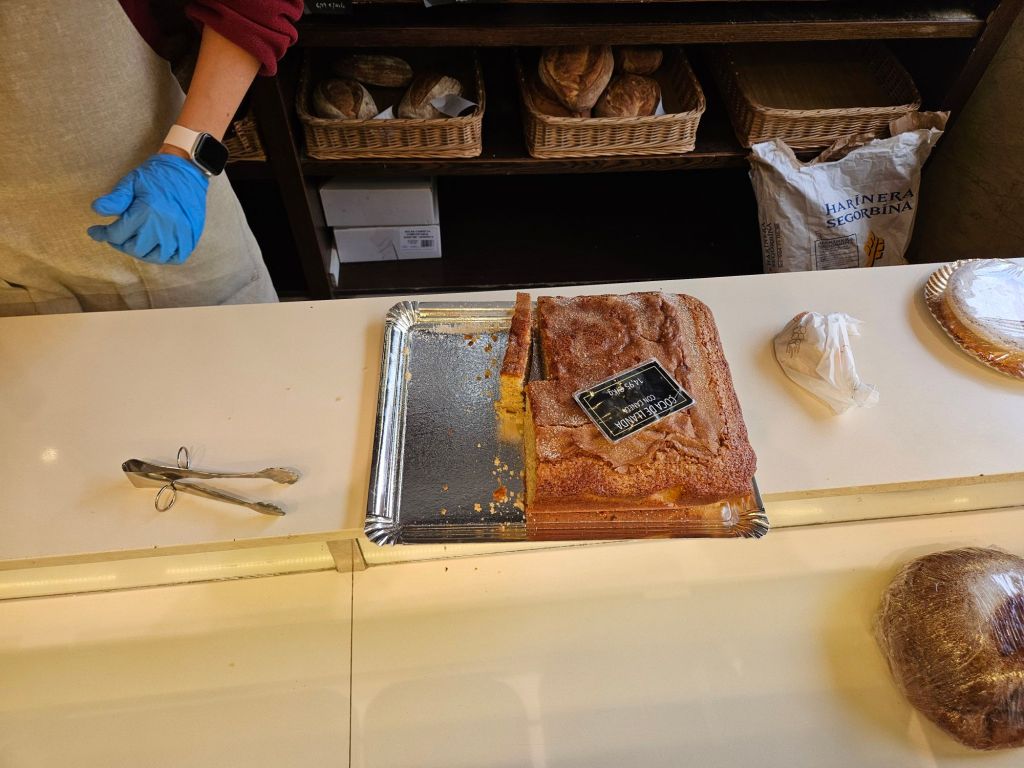
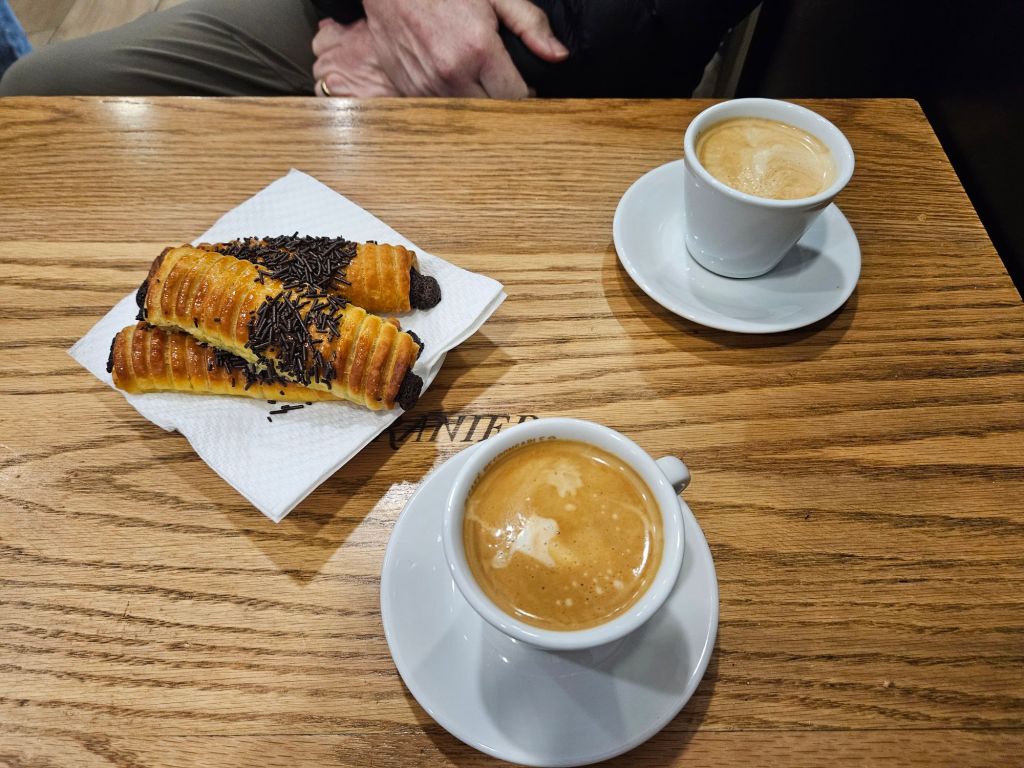
Breakfast pastries
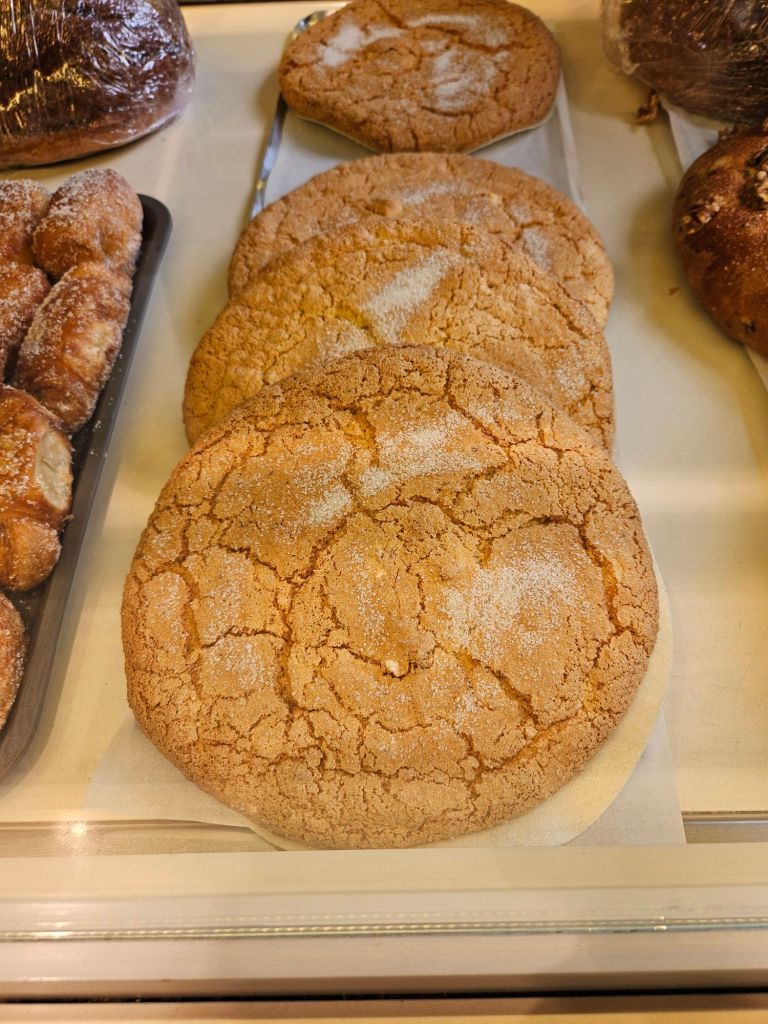
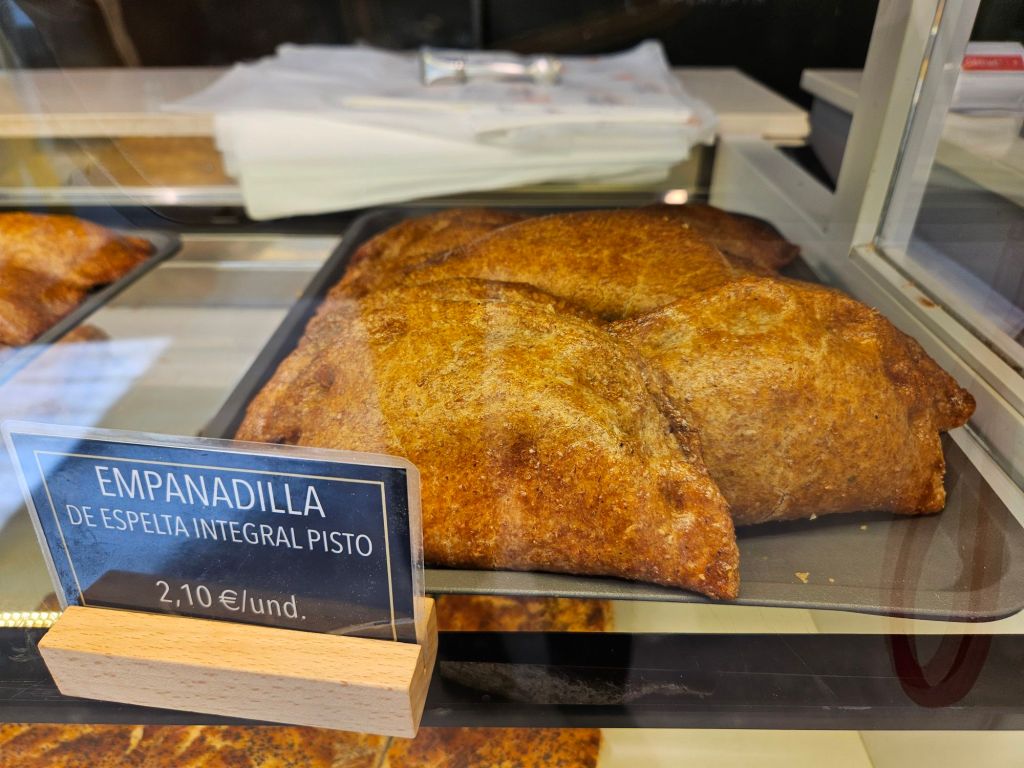
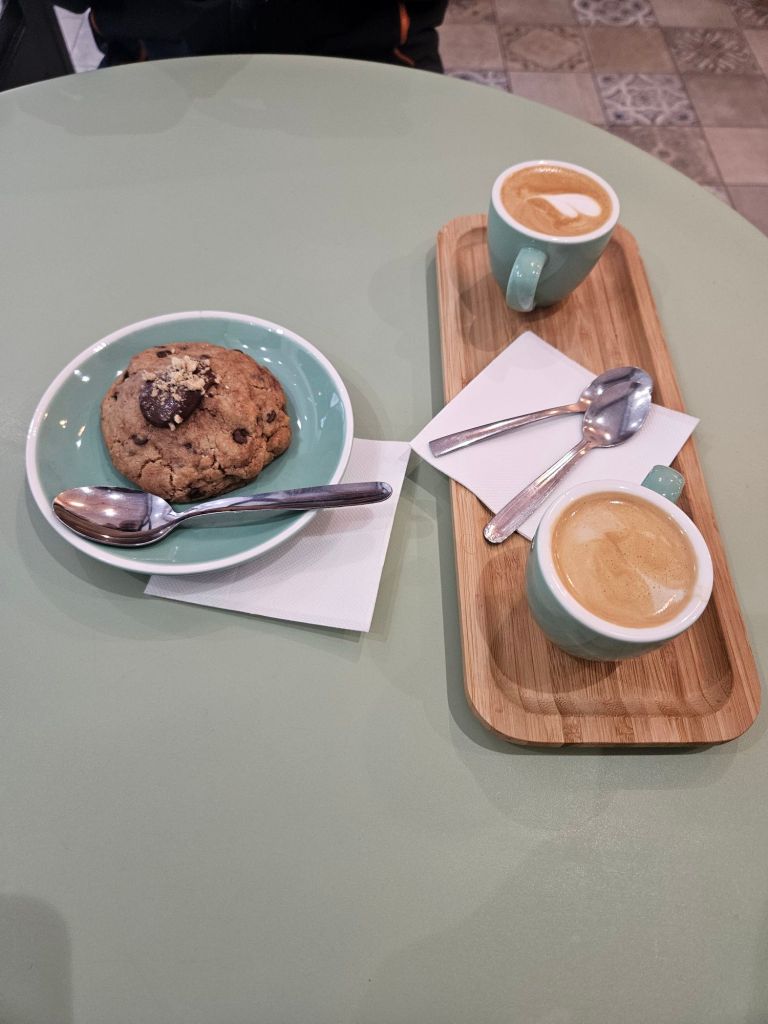
Or second-breakfast pastries, if we have eaten some egg and toast in the apartment before going out. R maintains the croissants and pastries here aren’t as good as those in France, and he may be right, but they’re still mostly pretty tasty. There was a bakery right by the school that made excellent empanadas with a multi-grain crust that managed to be robust without being dry or leathery. They also made delicious tiny croissants and passable chocolate chip cookies. We enjoyed an oversized cookie that I thought would be an almond meringue, but was more like a snickerdoodle with almond flour. Very sticky base. We were trying to peel it off the paper, and leaving quite a bit behind, before I realized the paper was rice paper and edible.
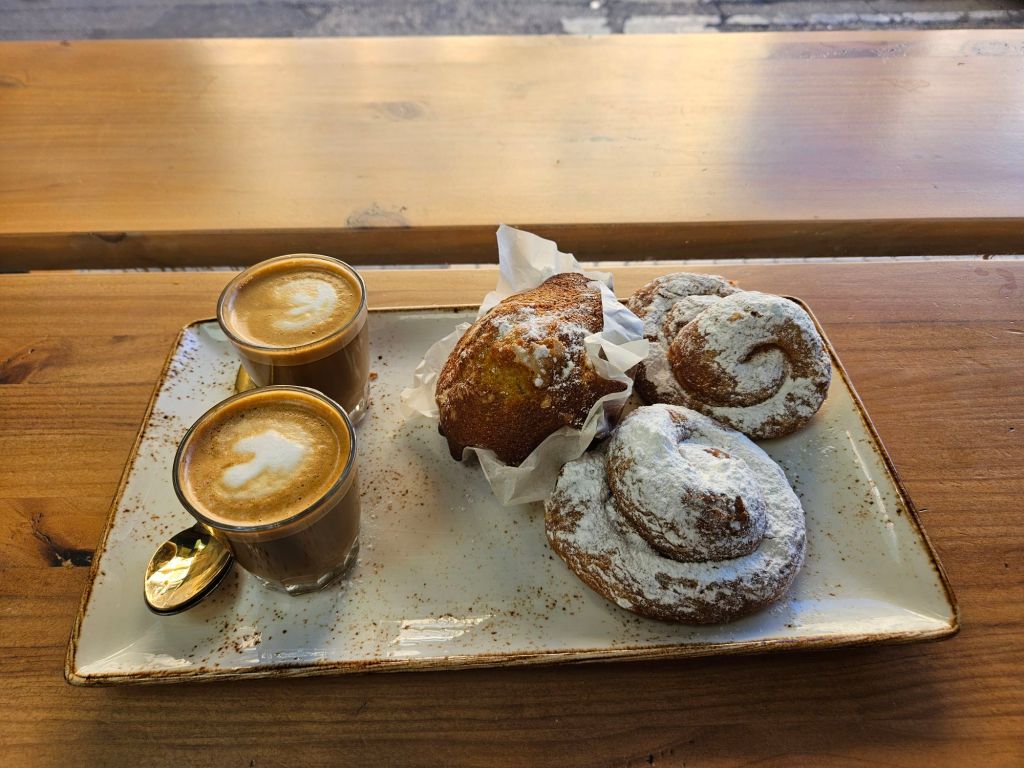
Our (and València’s) favorite coffee is the cortado, espresso with a little steamed milk usually served in a glass.
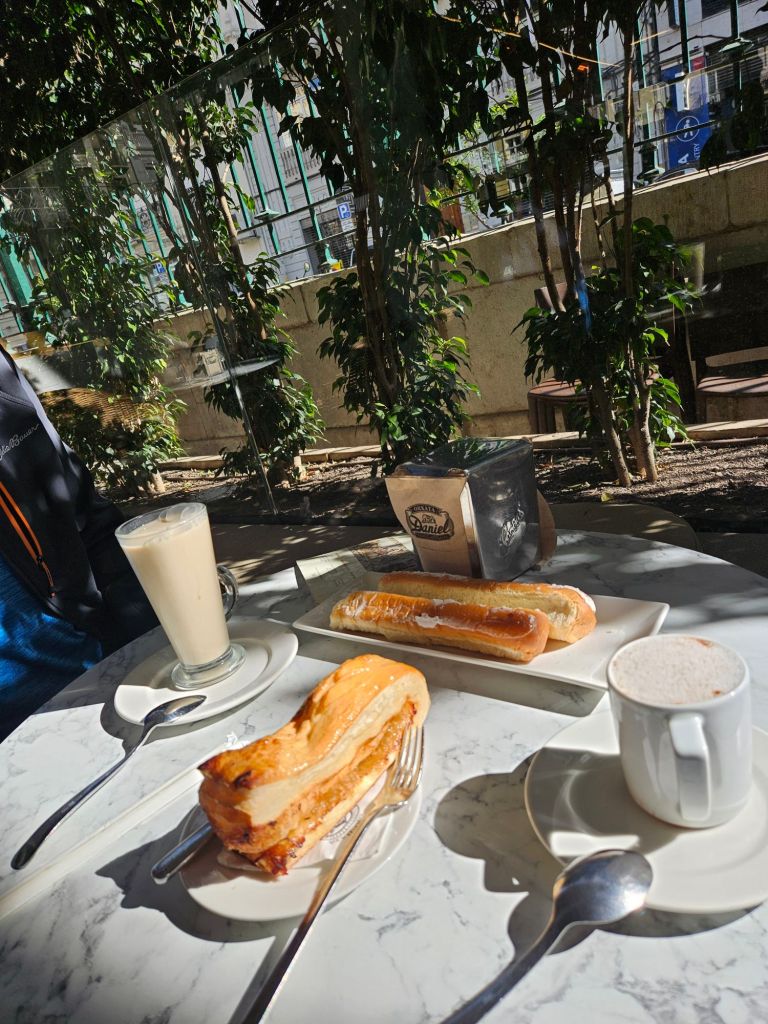
Fartons and horchata
If there is a signature sweet of Valencia it is a farton, usually served with a cup of horchata. Honestly, didn’t really work for us. A farton is a stick shaped pastry that resembles, more than anything else, a very cottony hot dog bun, dusted with powdered sugar. They are meant to be dunked in horchata, which here is a sweetened drink made from ground tiger nuts and cold water (in Mexico, horchata is made from corn). I can see how maybe this would be a nice sweet in very hot weather (its very light in the stomach), but otherwise I feel like there are better options.
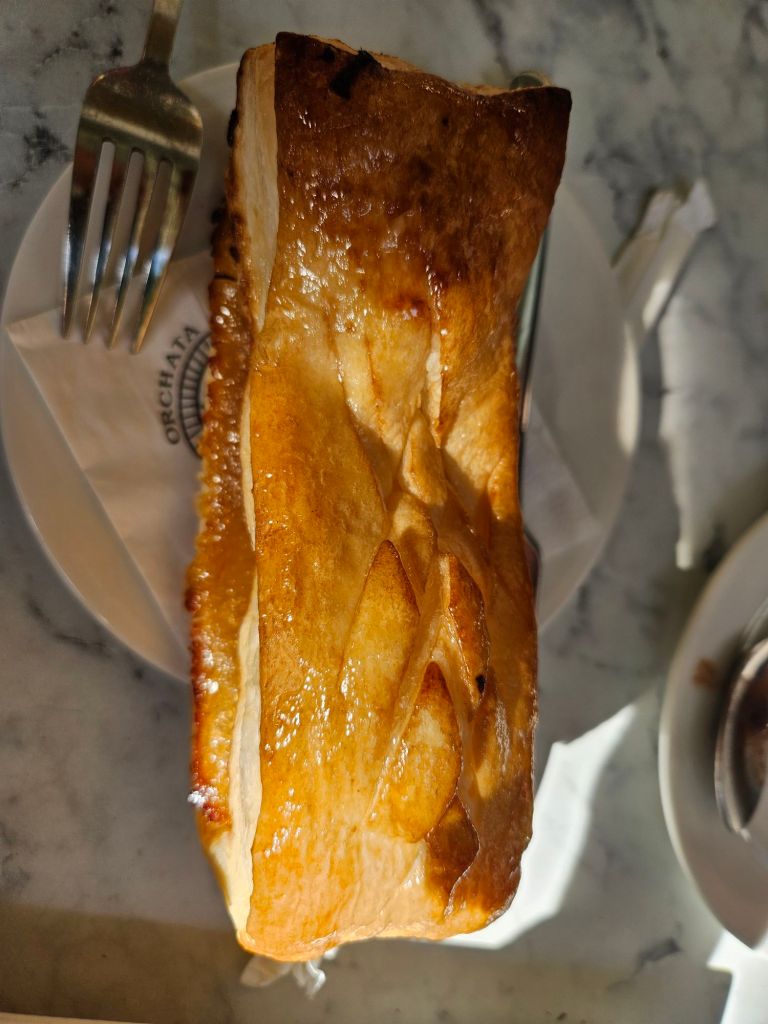
The fartons and horchata are in the back and on the left. The foreground is a folded puff pastry and a horchata chocolate combo.
Bocadillos
A signature Spanish snack. Very plain crusty bread (think baguette) made into a sandwich with thin shavings of ham. Maybe a thin slice of cheese. Filling, and the ham is excellent, but overall it’s very dry and hard work. No pic here.
Tapas and “El menu”
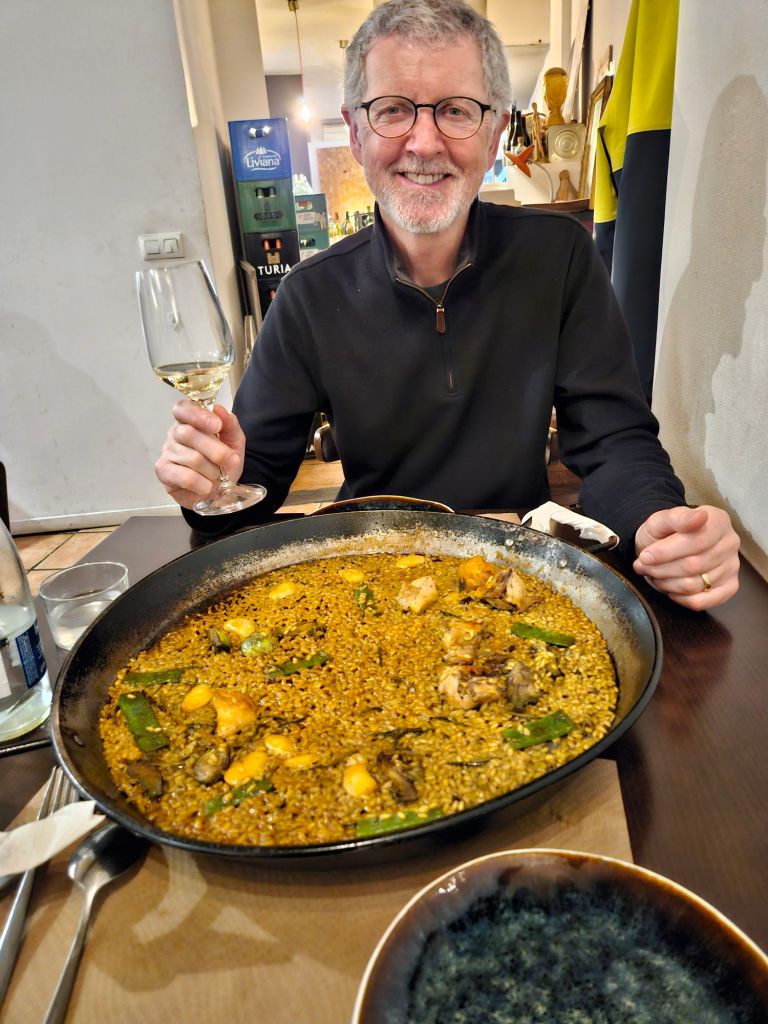
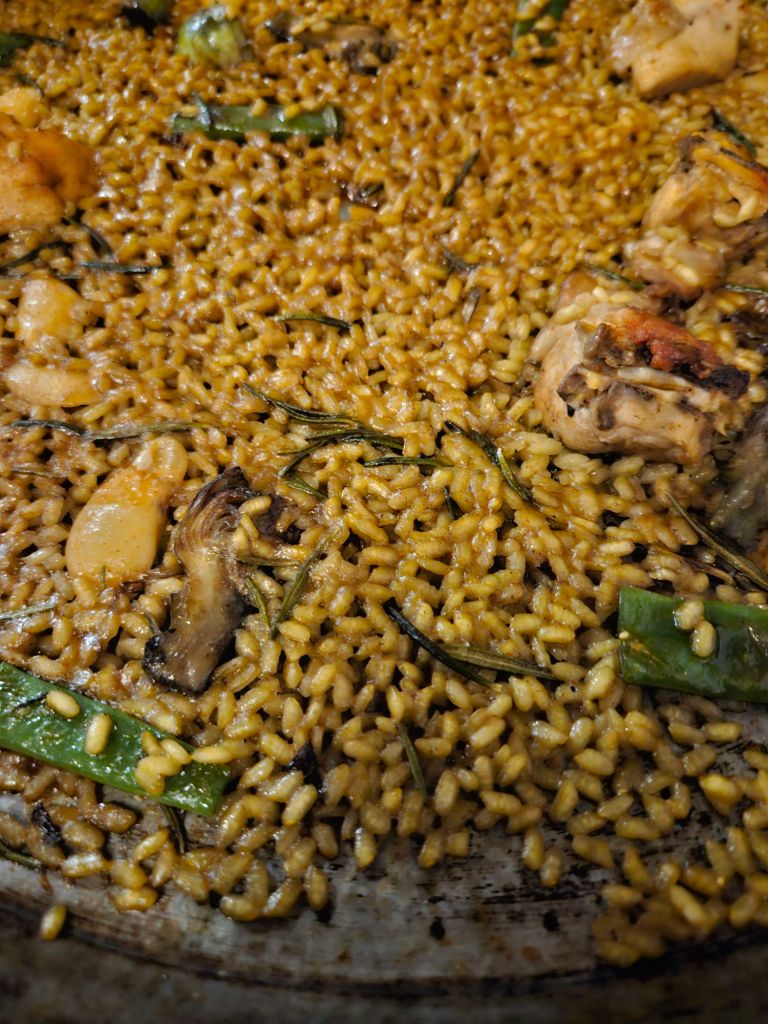
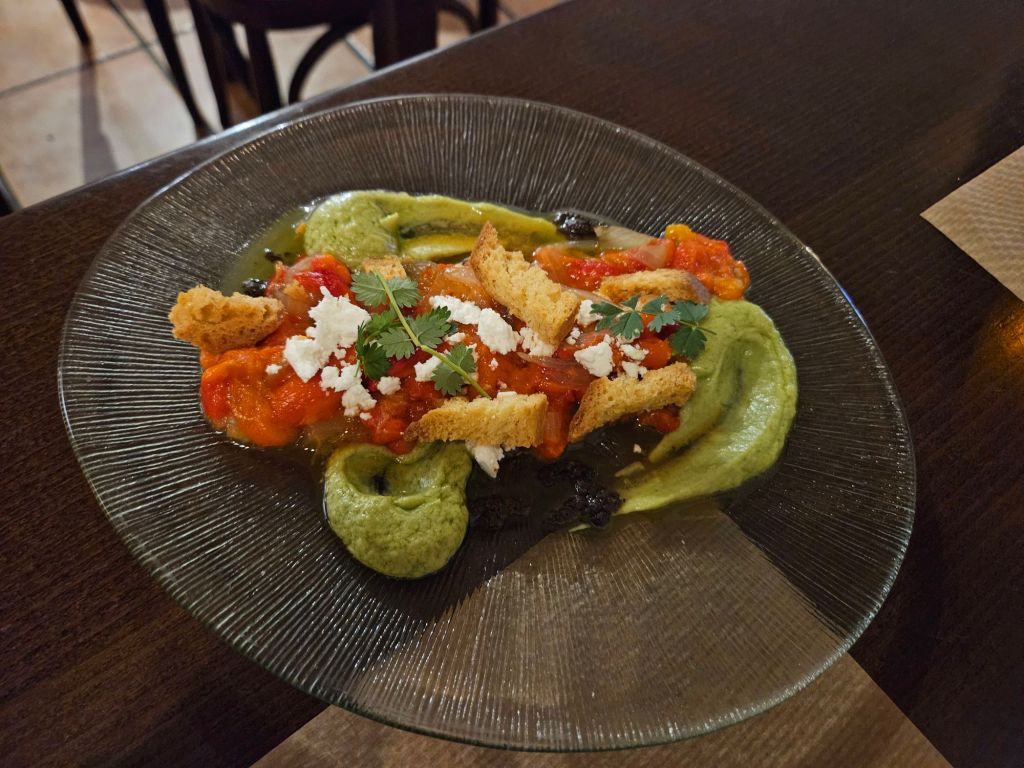
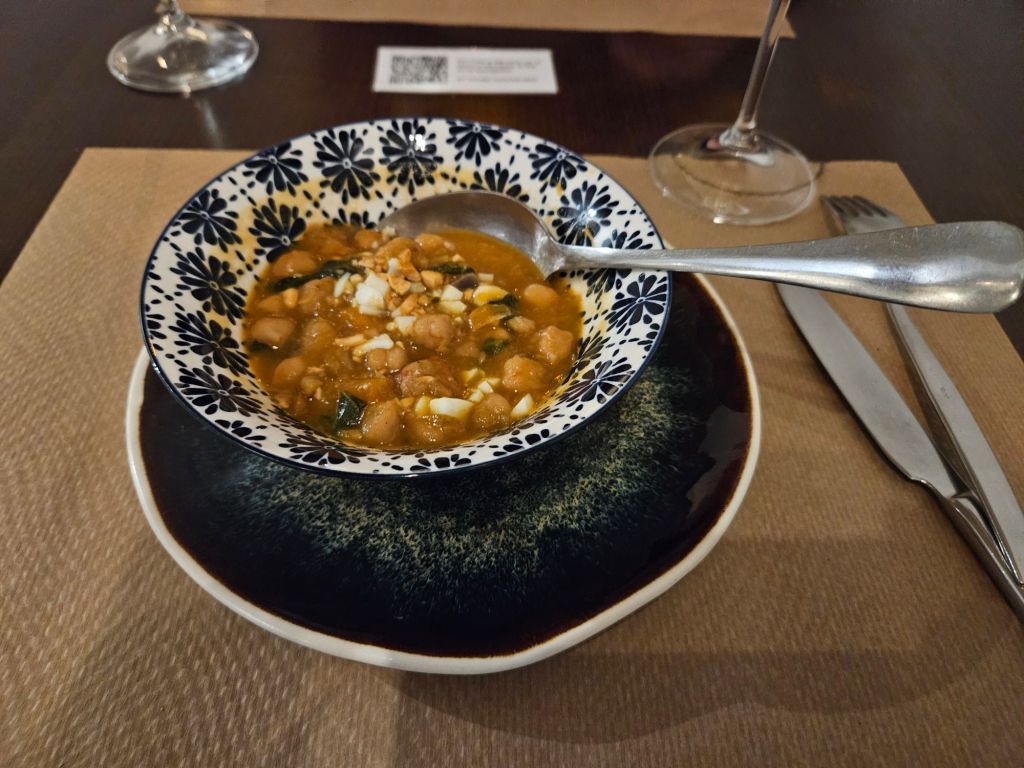
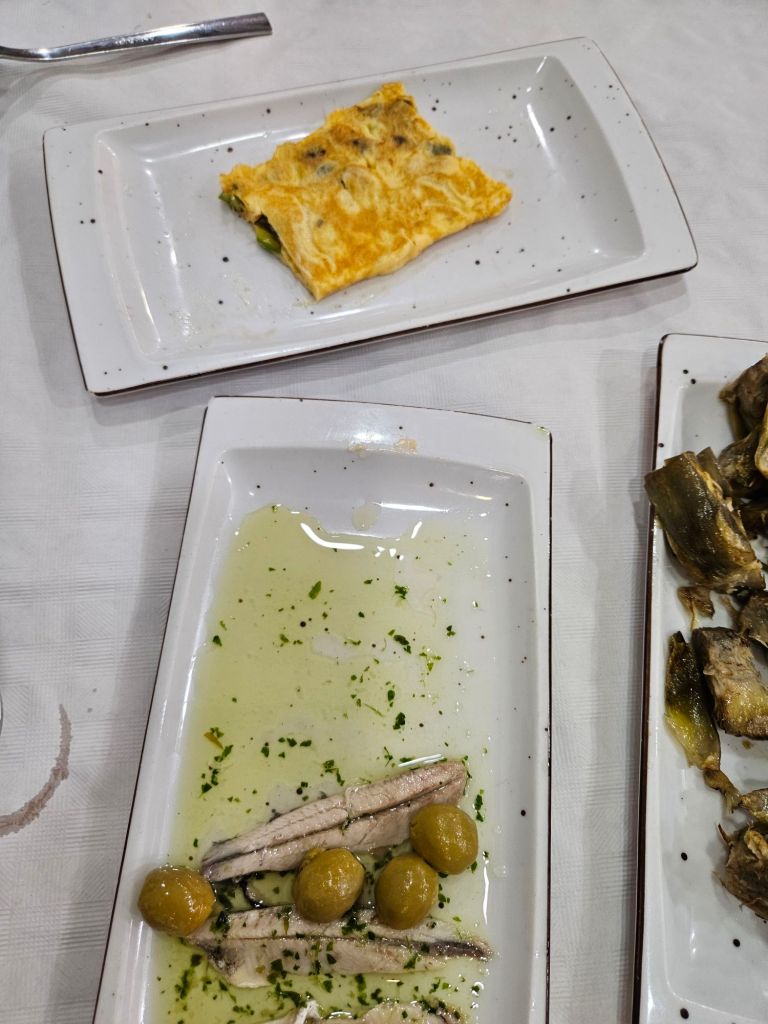
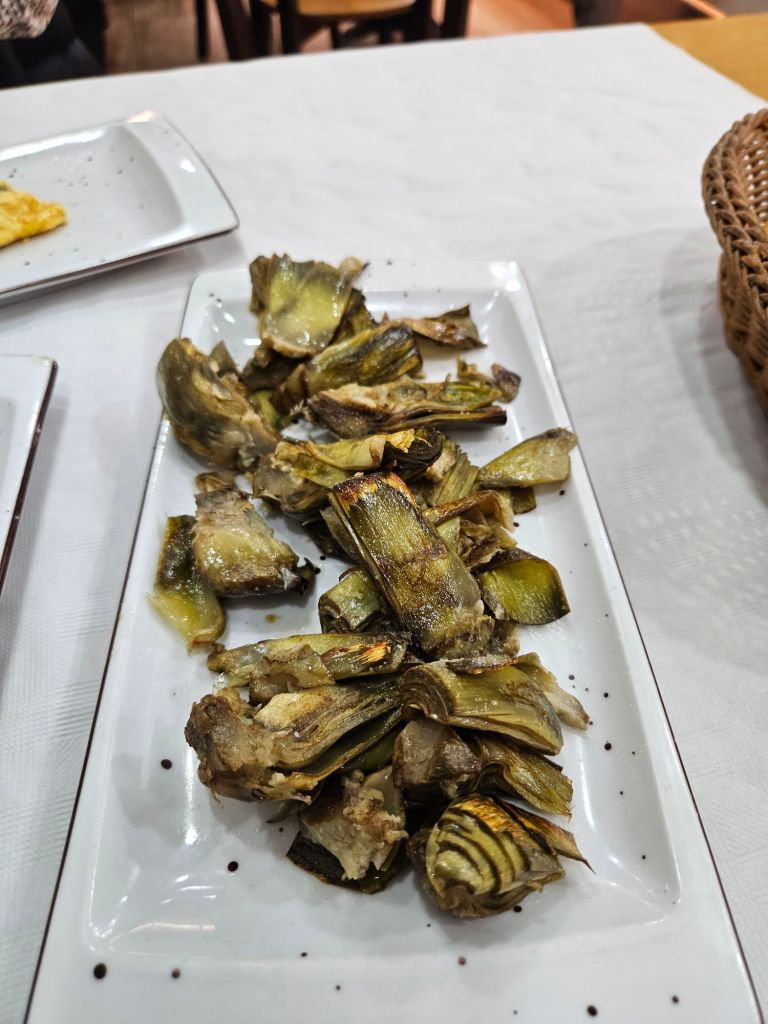
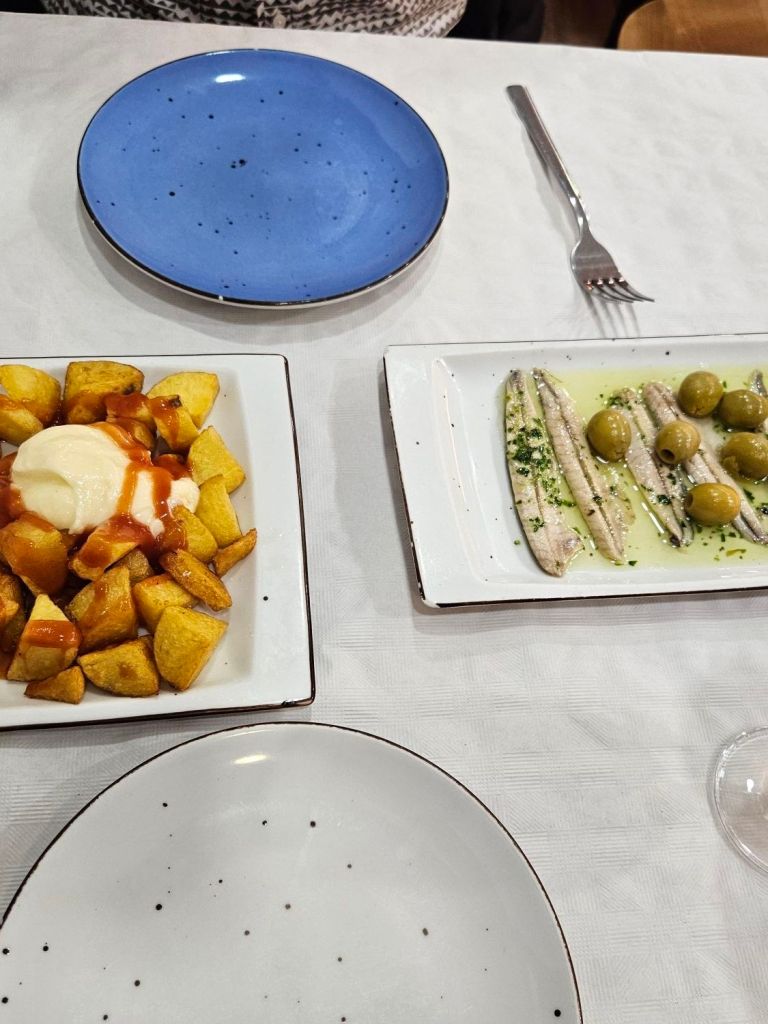
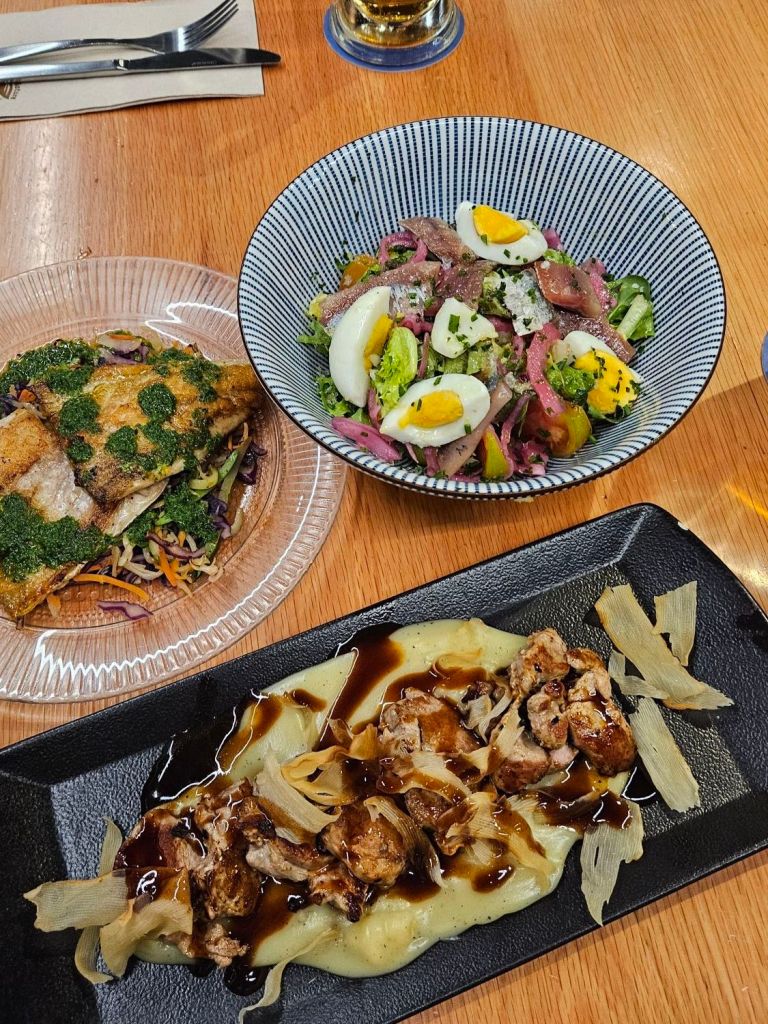
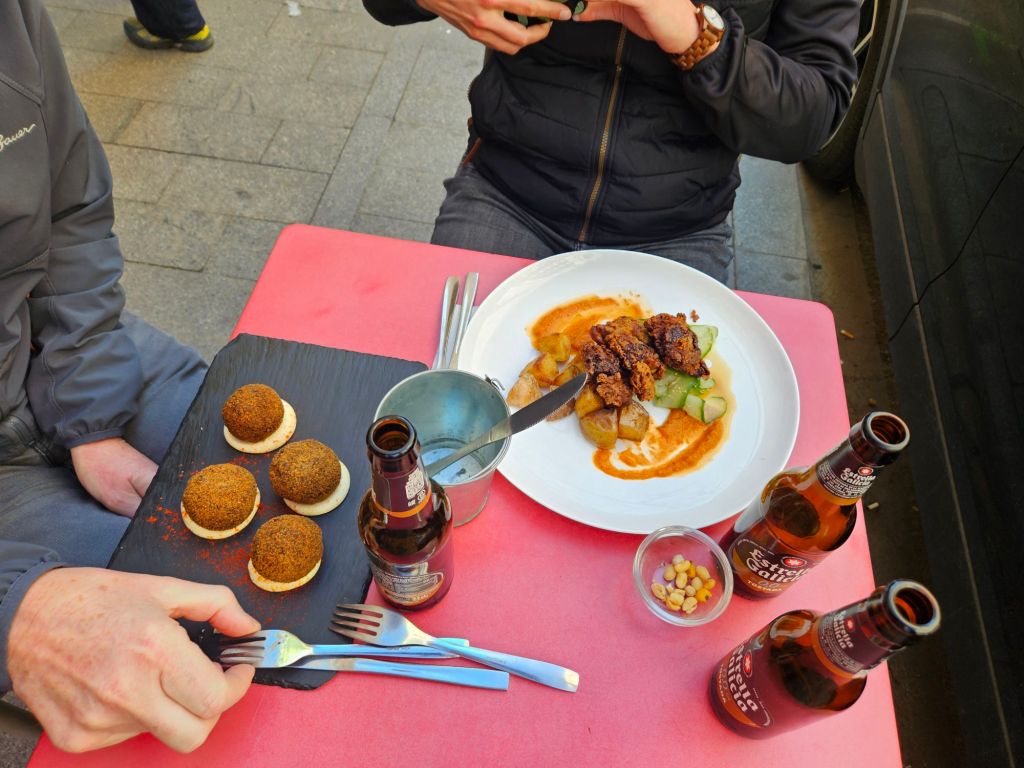
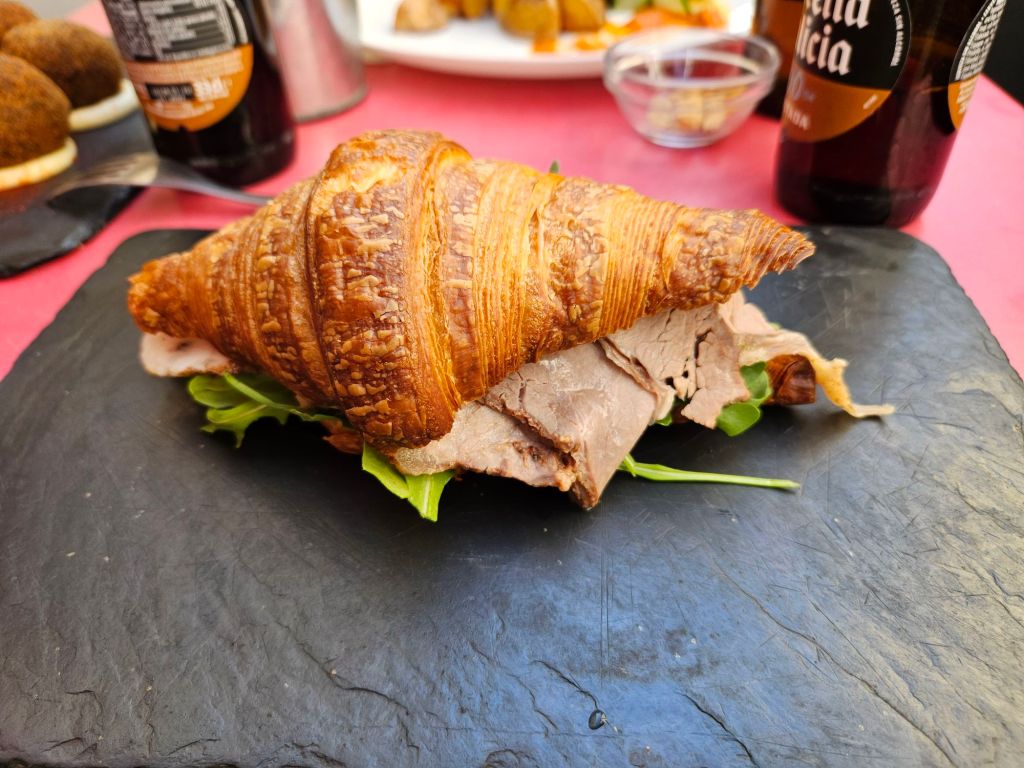
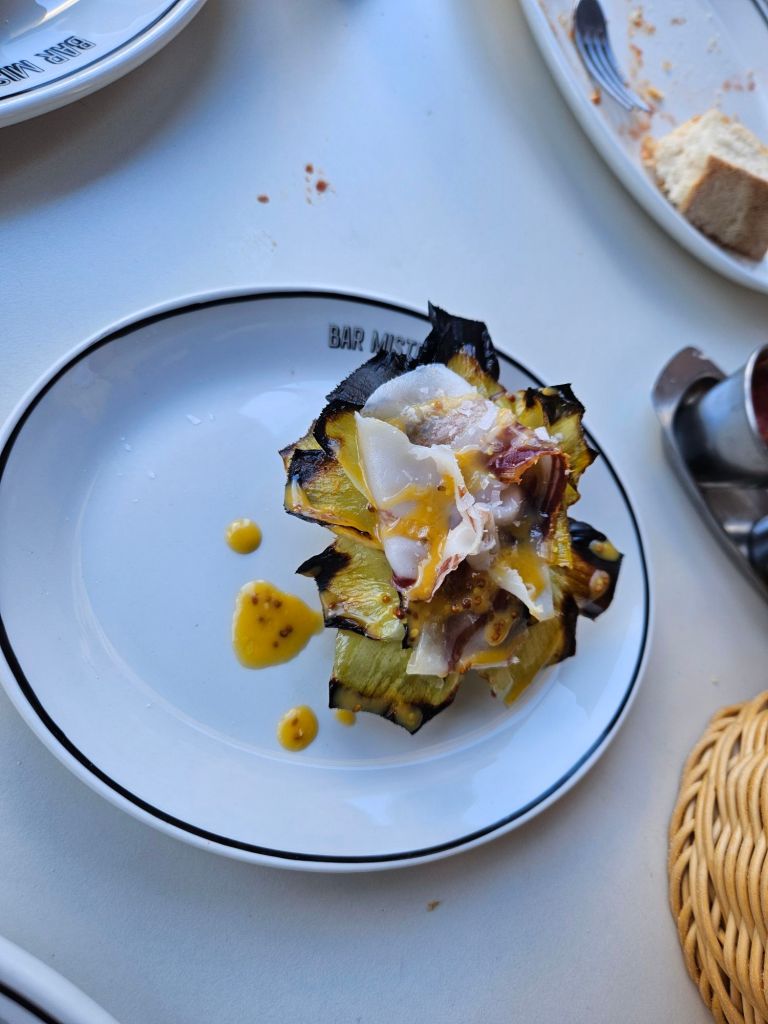
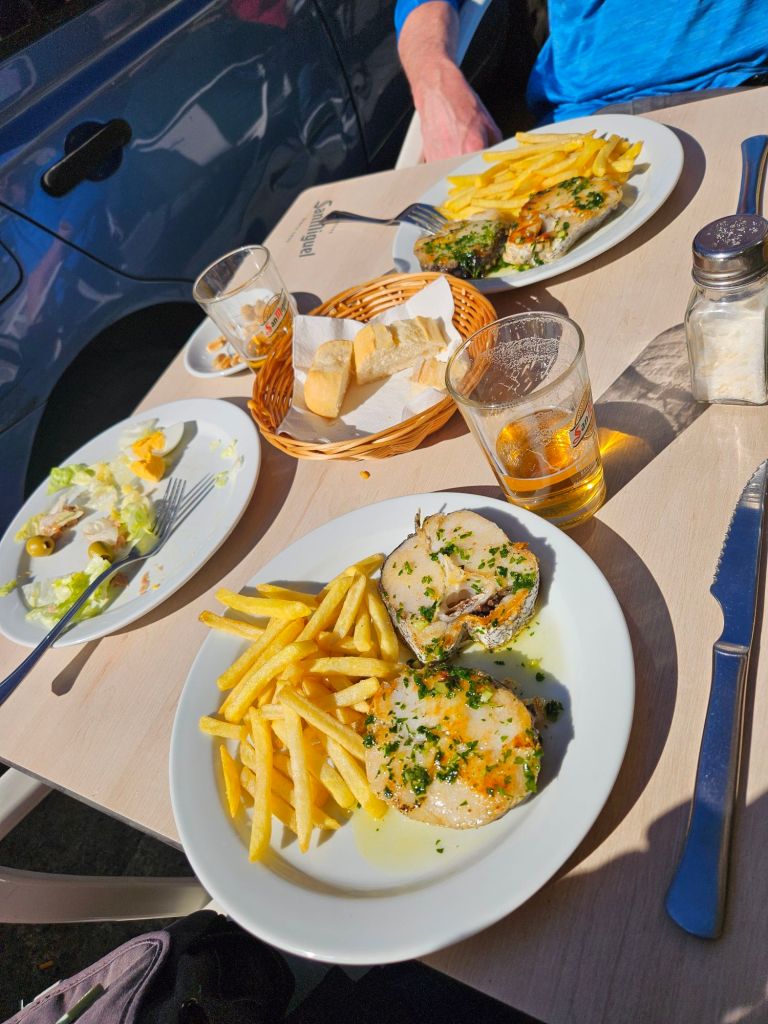
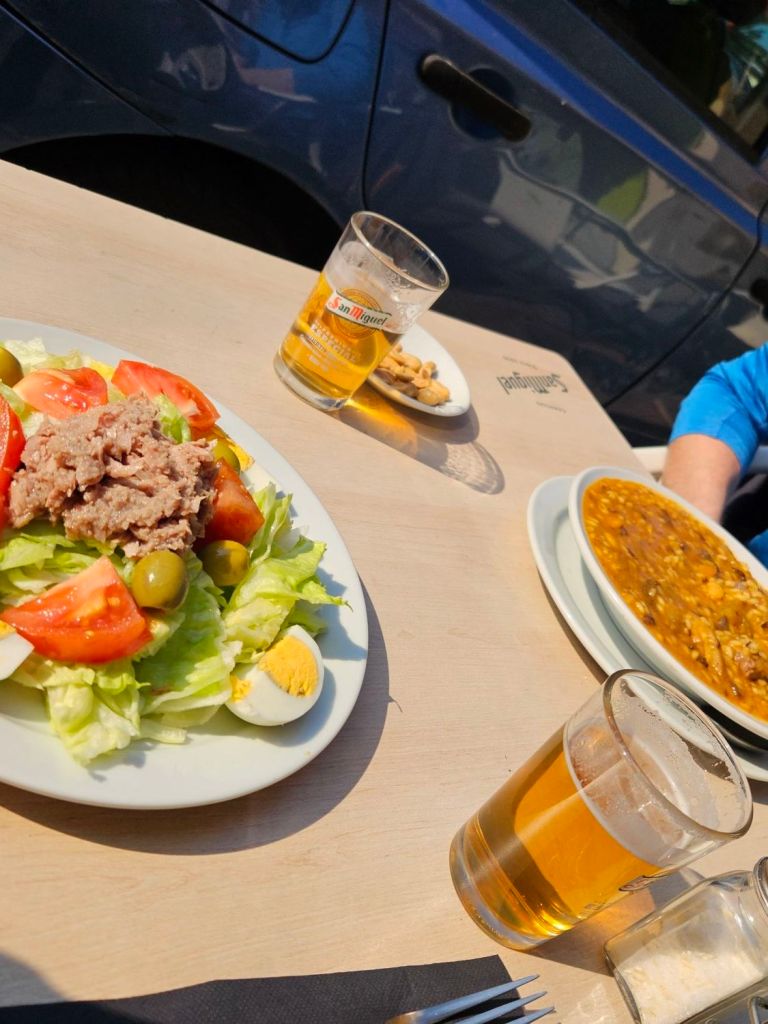
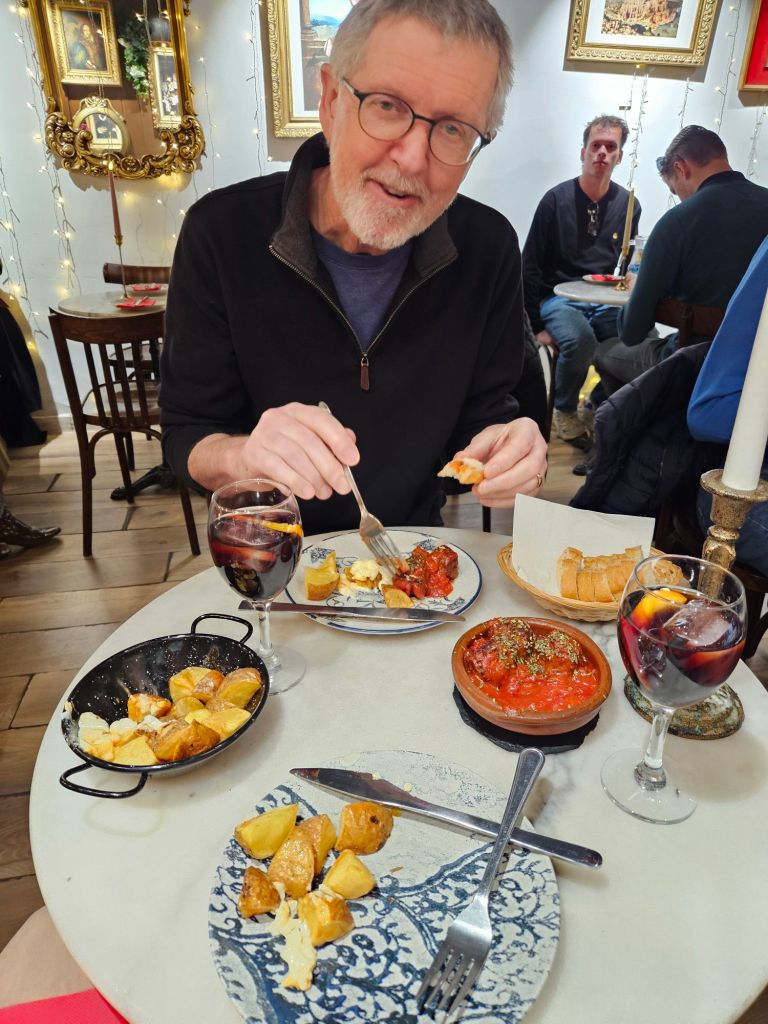
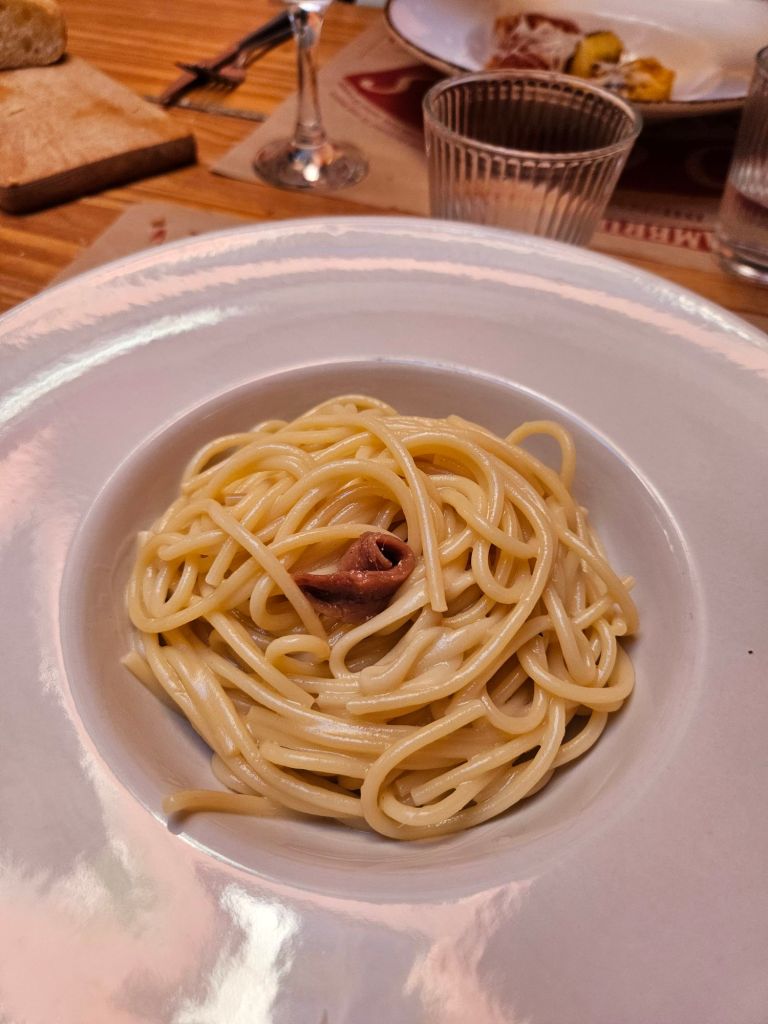
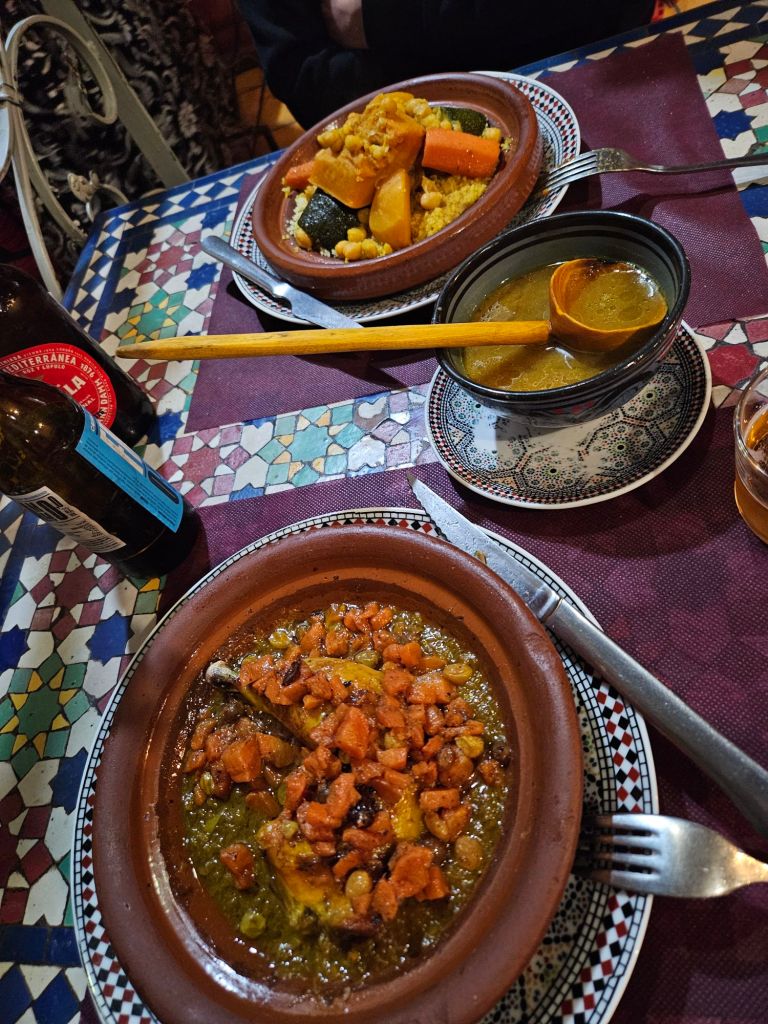
And here’s where things start getting especially yummy. “El menu del dia” is the preset lunch option at restaurants. Usually 2 or 3 courses, with a drink included. A budget friendly way to eat a variety. Artichokes, asparagus, bocarones, patatas bravas (roast potatoes topped with aiolli and spicy red sauce), olives, paella. And in the non-Spanish, but still excellent, category, are pizza Napoli, Moroccan tagine, and pastas.
Cheesecake
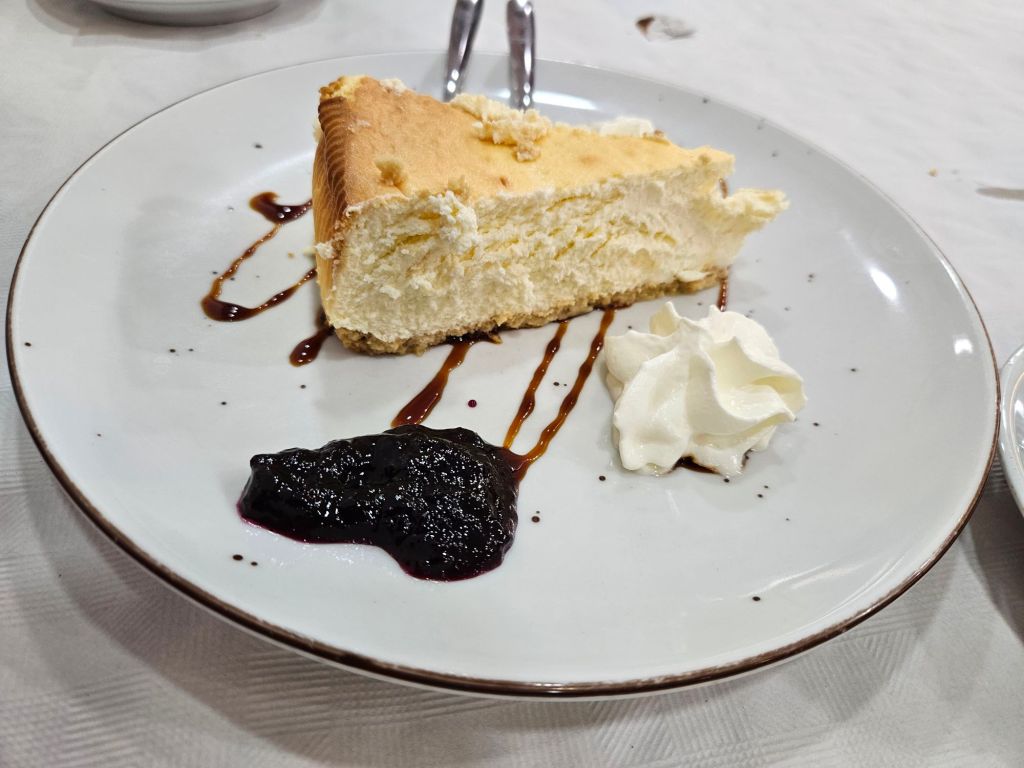
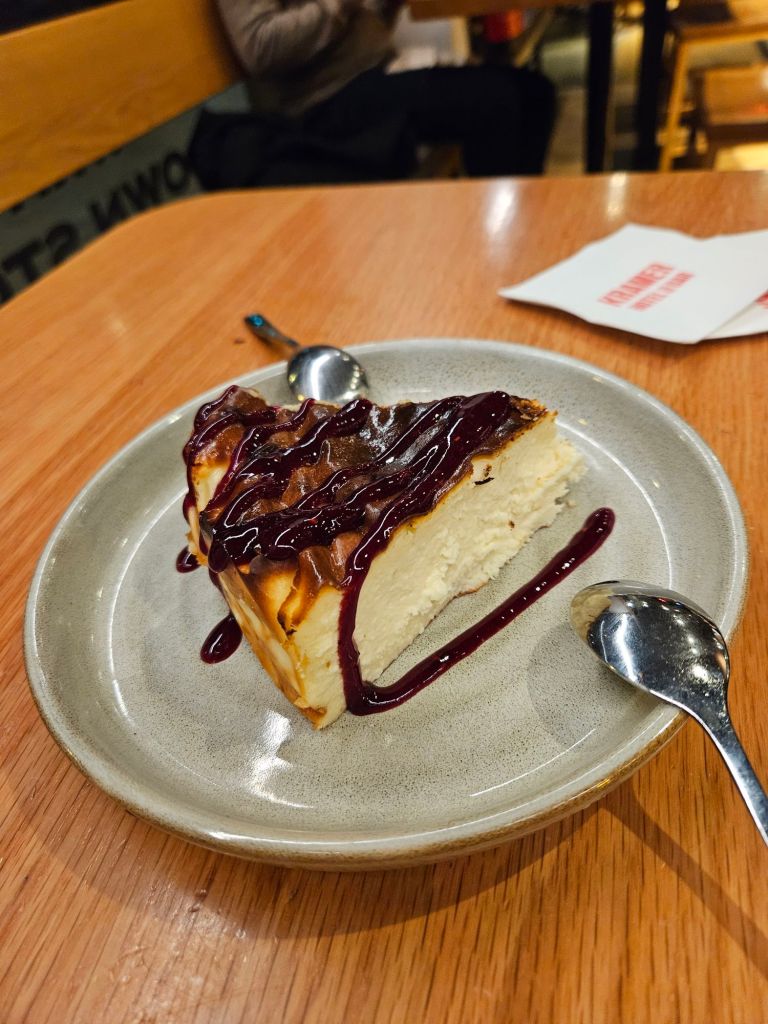
Cheesecake is a big thing here, and one of R’s favorite things. Usually it’s made without a crust. Basque cheesecake is usually cooked until very brown on top, while other styles are judged by how much they ooze across the plate when sliced. R is trying as many as he can squeeze in. Still hasn’t found the perfect one, so experimentation will continue.
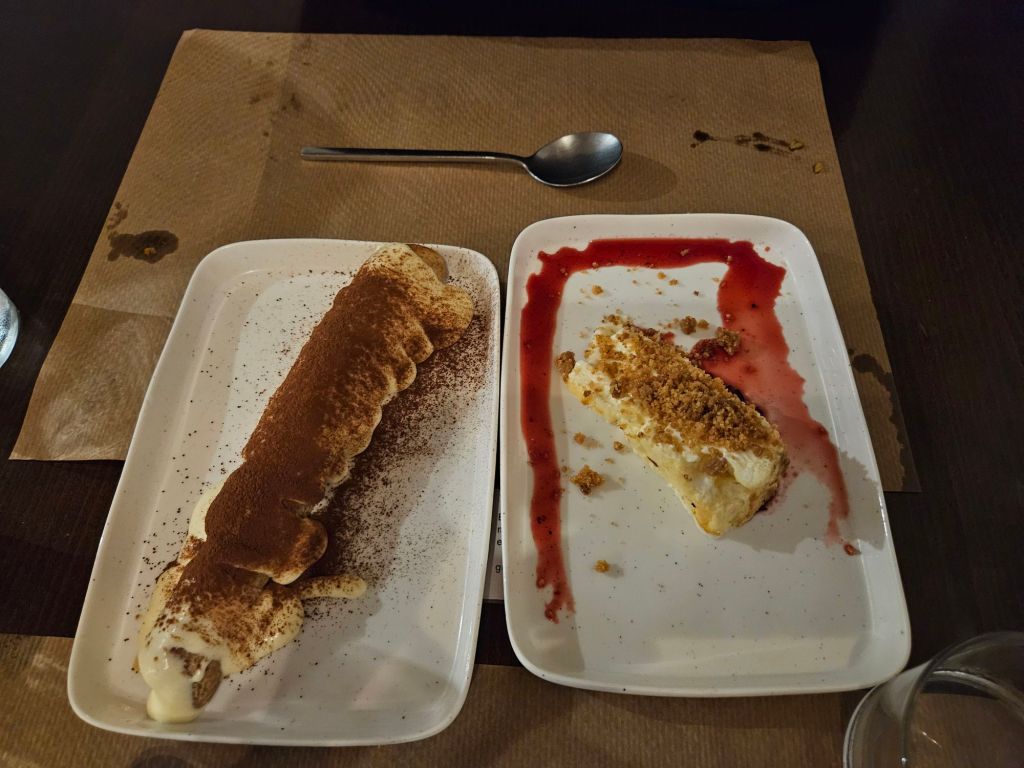
On the left, above, is the best use of a farton I’ve tried–fartonmisu, a tiramisu made with a farton. Yum.
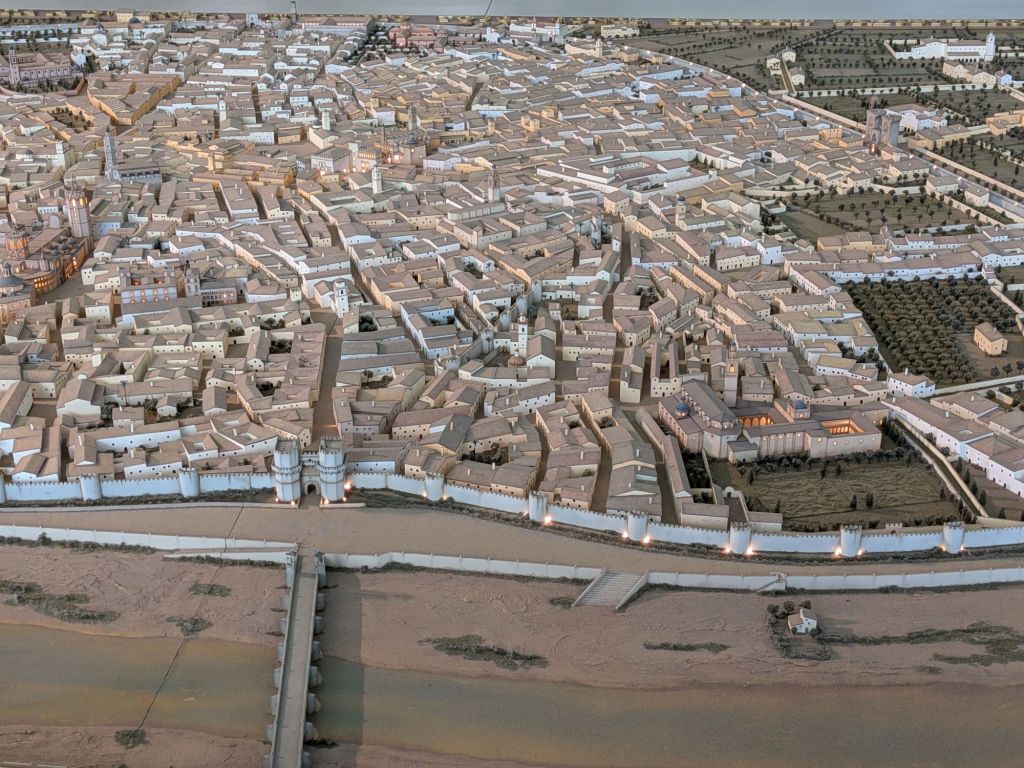
The Roman colony that eventually became Valencia was built on a river island. By the Islamic era, it was ringed by large walls–with 7 gates–and the edge of the city followed the curve of the Turia river. A small moat around the walls helped protect against innundation.
(Note that there was an Iberian settlement here before the Romans, and no doubt someone else here before that–Wikipedia only takes me so far.)
Not a 300 year old drone photo, but a beautiful and minutely accurate 3D model of the city, in one of the museums, recreating what it would have looked like down to the last building and alley, from a famous map of 1706. The Turia River, as it then was, is in the foreground, with the Torres del Serrans – the main gate – to the middle left.
Over the centuries, the proximity to the river was both a strategic benefit and a flooding risk. This came to a head in the mid-1900s when two devastating floods lead to the moving of the river to a new course going round the south side of the city.
The redirected river did its job of protecting the main city during the Valenican floods of 2024, but adjacent communities to the south were devastated in one of the worst natural disasters in recent years. More than 230 people died after an intense storm dropped nearly a year’s worth of rain in a day.
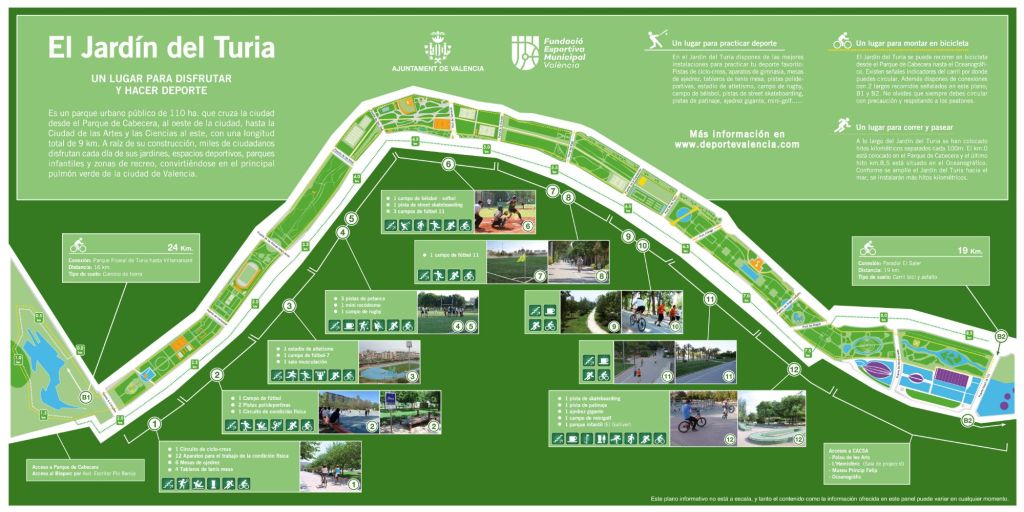
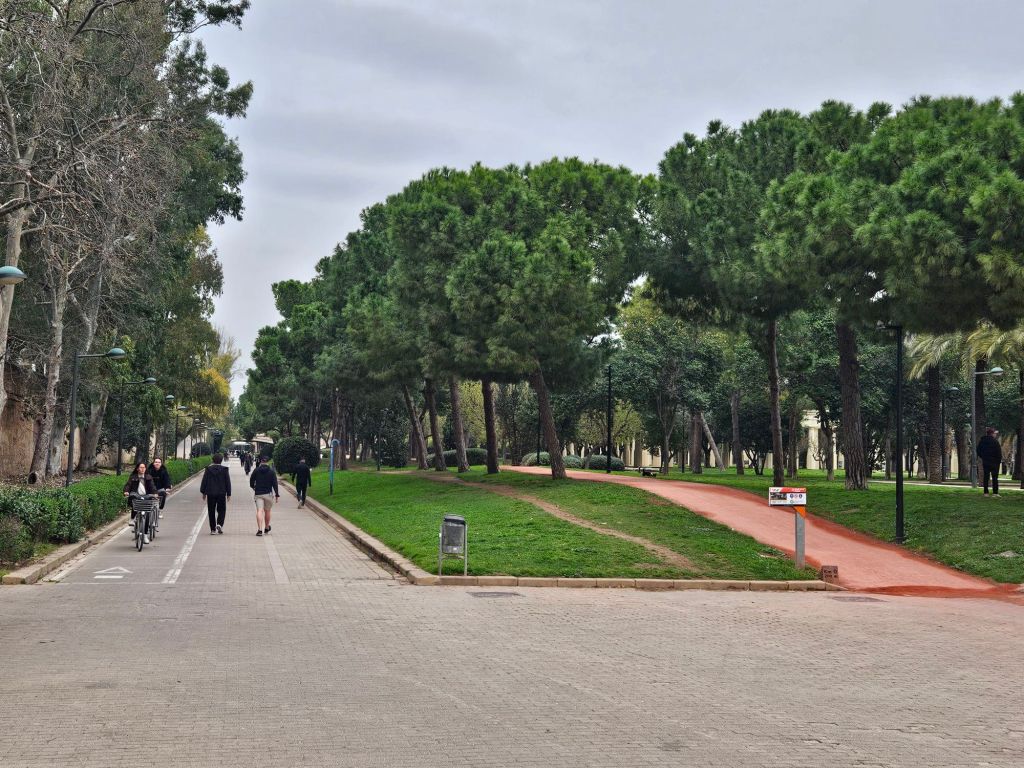
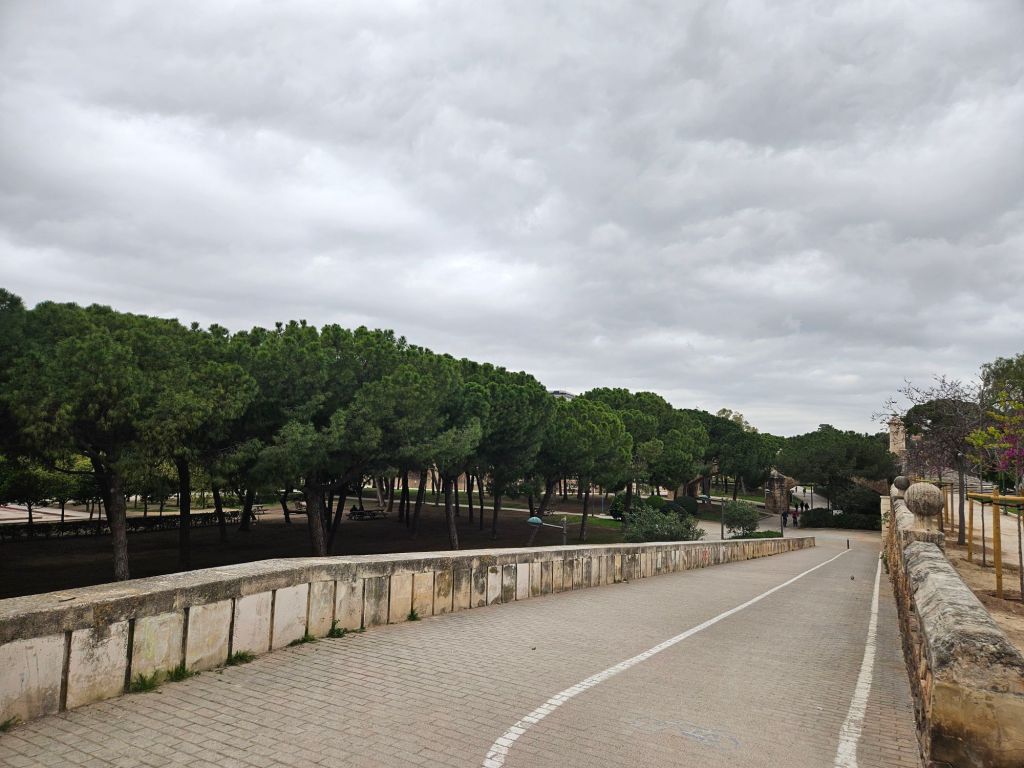
The old river bed was abandoned for years, with various mayors periodically surfacing a plan to turn it into a motorway better connecting the port and the airport. Thankfully, that idea never succeeded and instead, the river bed was converted into a long narrow park curving round the old town.
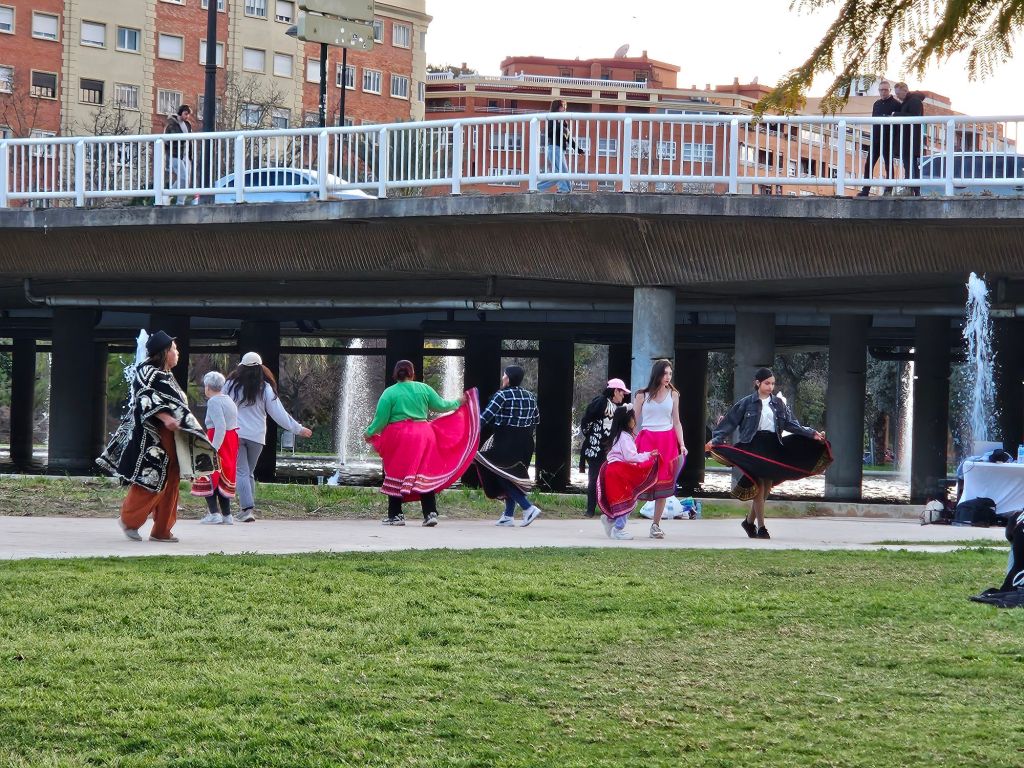
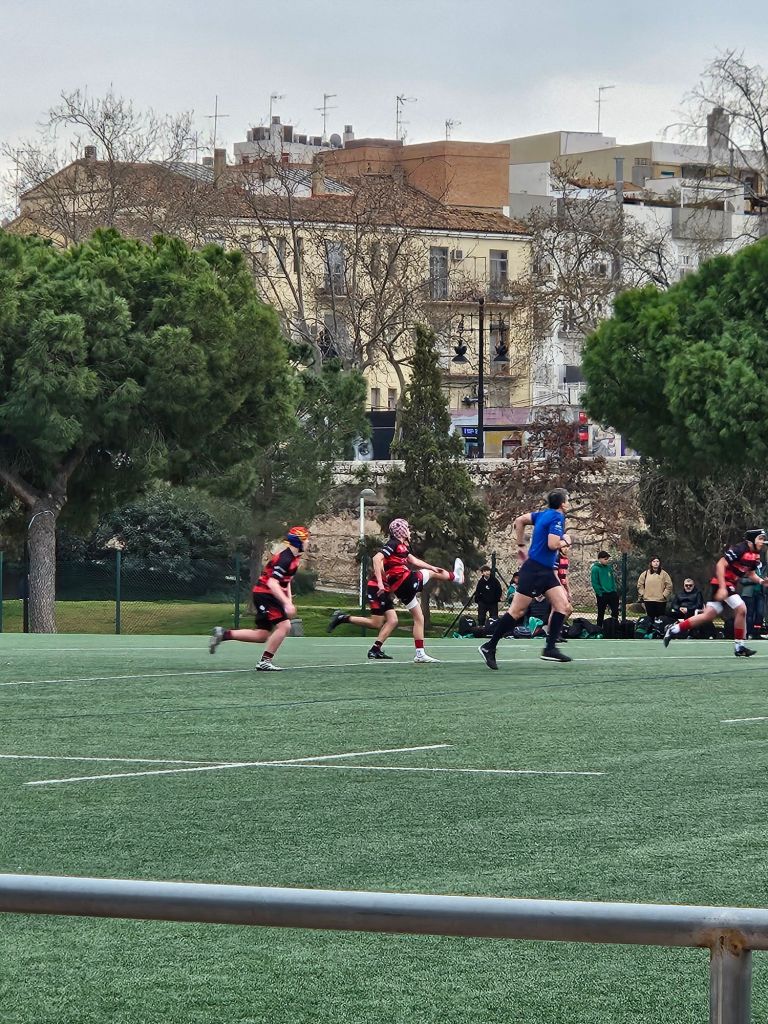
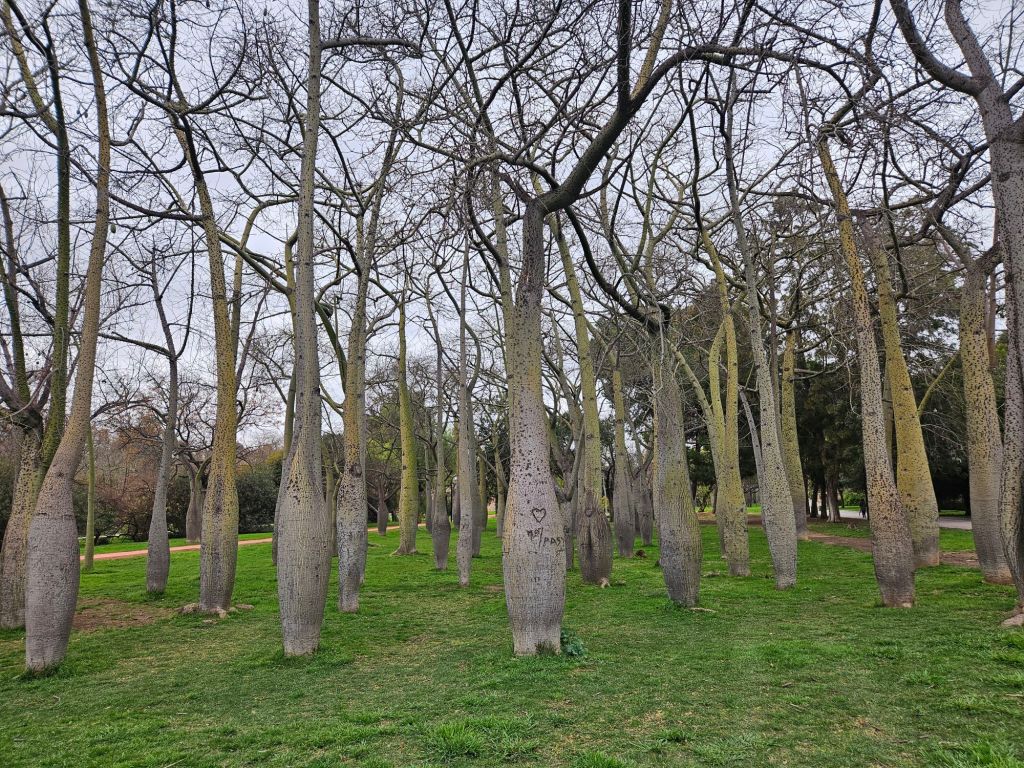
The park stretches more than 9km and features a series of green spaces. Gardens, soccer, baseball and rugby pitches, fountains, playgrounds and green spaces are criss-crossed with a series of walking, running, and biking paths. (Note to the tourist–make sure you’re walking on the right one. Those folks on their bikes and motorized scooters move fast, have the right of way, and don’t appreciate their commute being slowed by clueless wanderers.)(Guess how I know this?)
We have so enjoyed having this green corridor as a way of moving through the city and have delighted in all the ways the space is used. If you have to move a river, this is an excellent way to make use of the river bed.
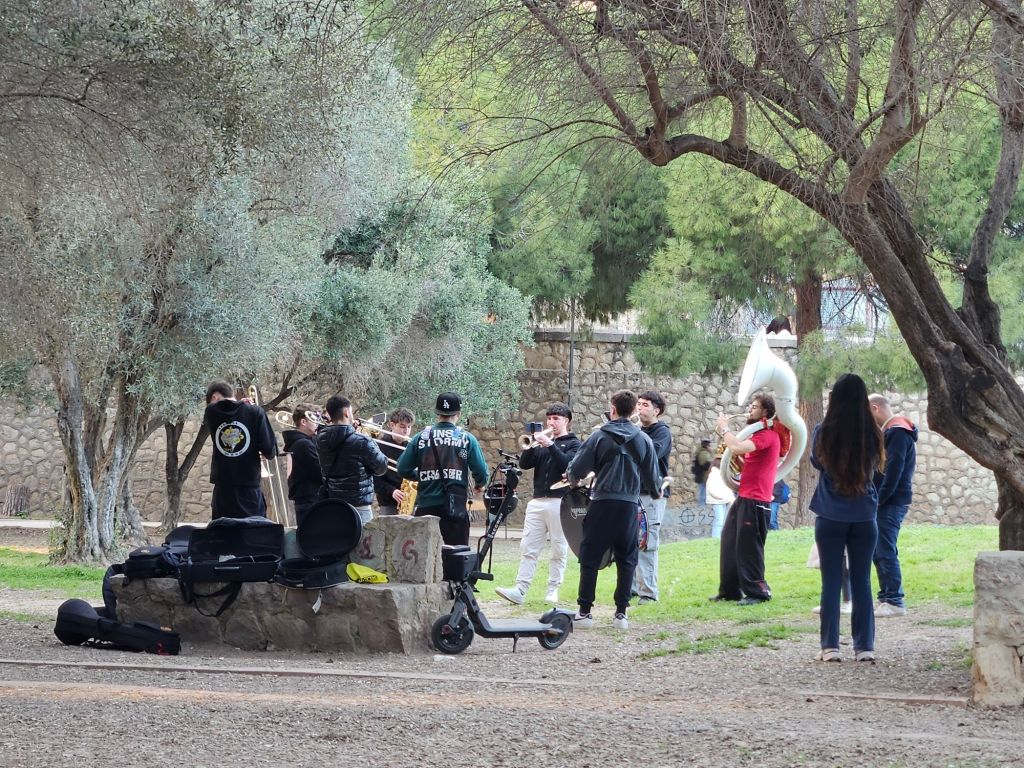
R here. Loads of music practice in the park too. Whether this is normal or preparation for Fallas we’re not sure, but we sat on a wall for 20 minutes listening to these guys:
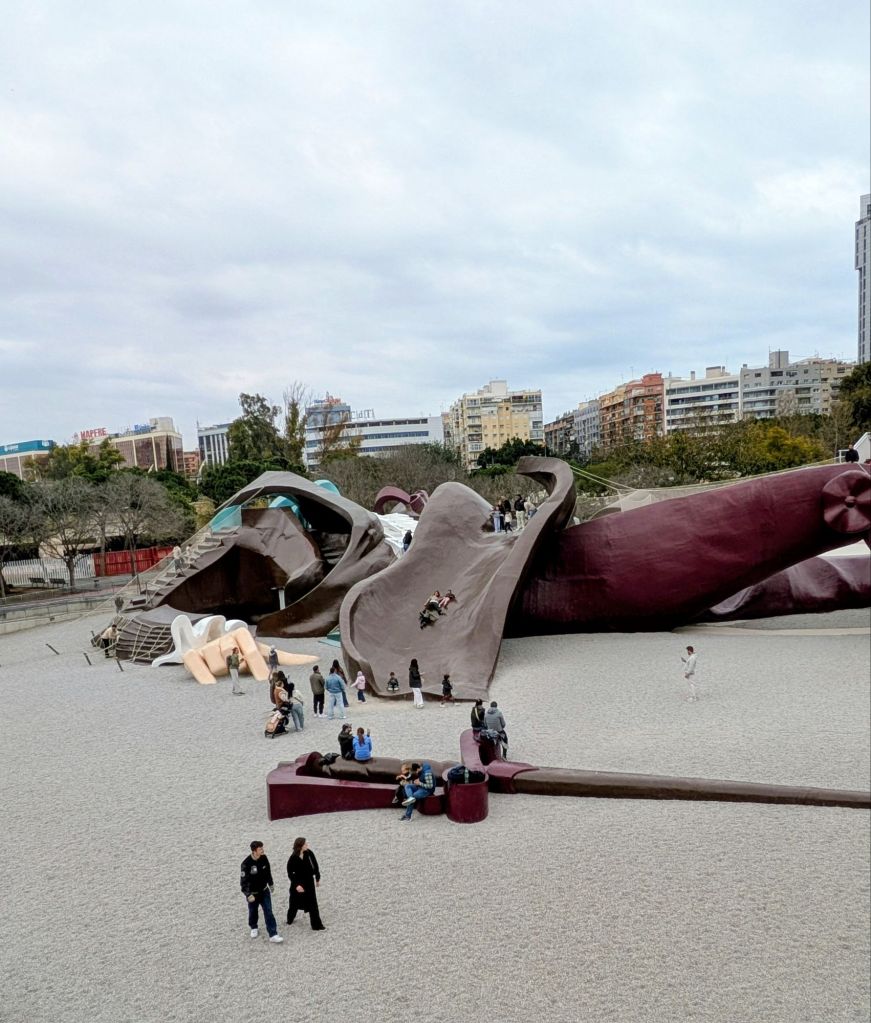
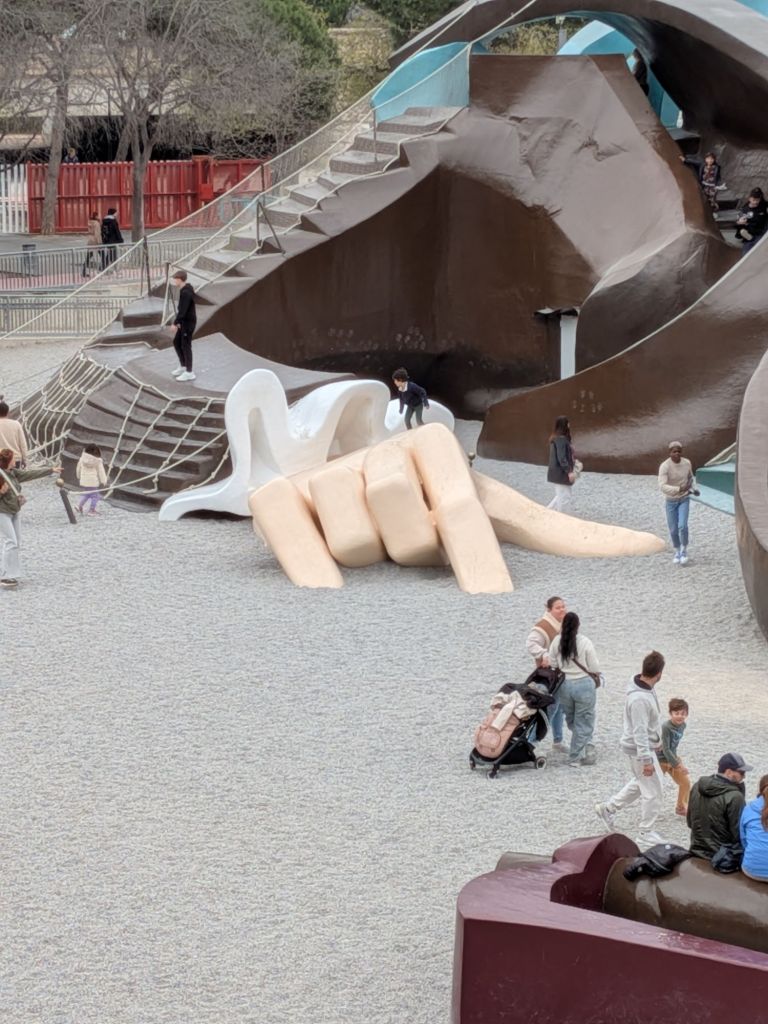
There’s a wonderful playground / play structure in the park called Parc Gulliver, consisting of a giant (40 meter?) tied-down Gulliver on which the city’s Lilliputians can play.
For you literature nerds out there: it’s Gulliver’s 300th birthday this year. Gracias a Sr Swift: one of the dozen or so greatest books ever written, IMVHO.
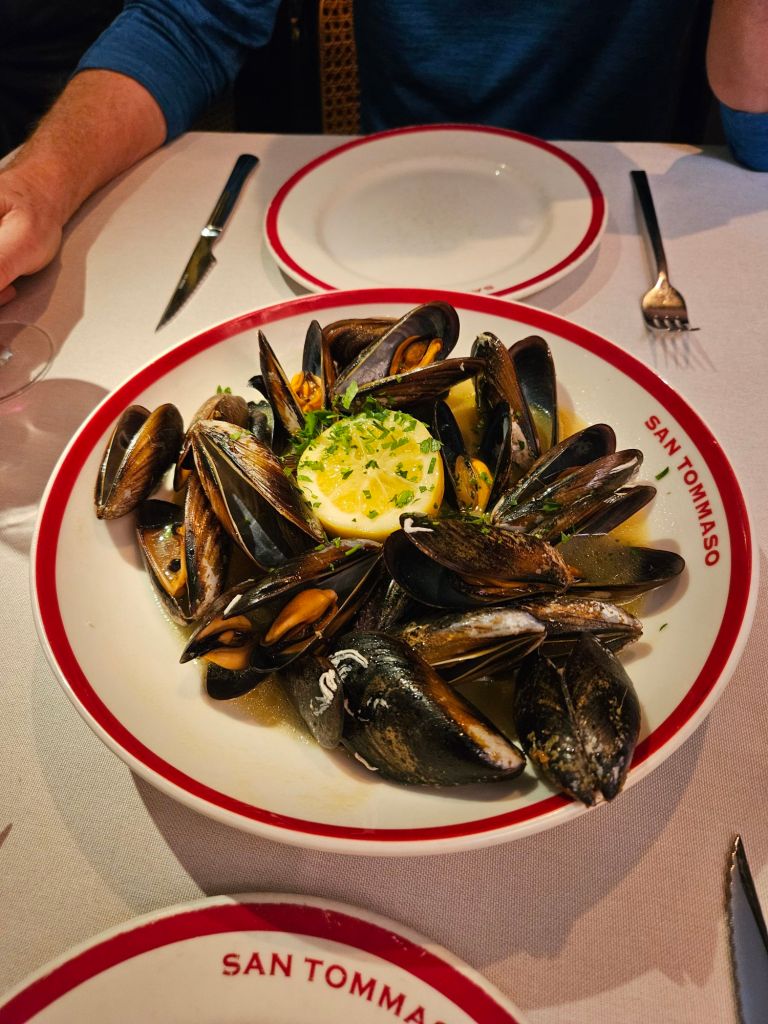
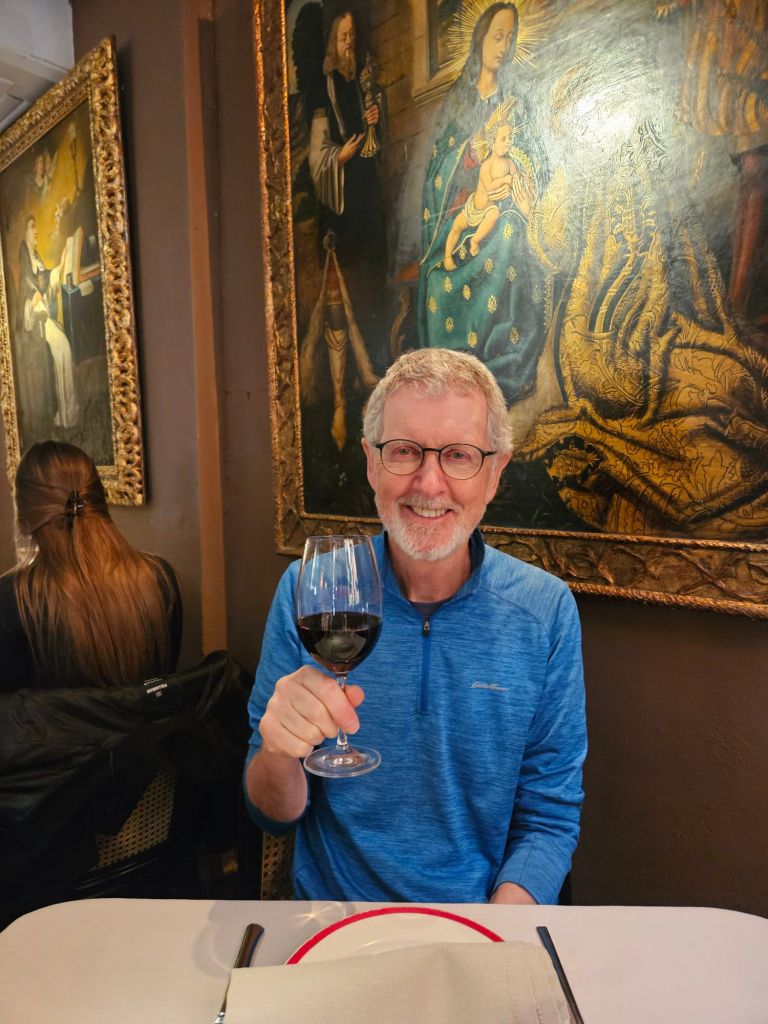
After our trip to El Museo de Bellas Artes, with detour to Hospital Clinico, we decided we had earned a nice lunch. Thanks to a restaurant list shared by Mario at the school, we decided to go Italian at Prosciutteria Tommaso. Got in line for lunch around 3 (very Spanish) and were seated – at a nice corner table upstairs, surrounded by art – around 4. What followed was indulgent and delicious.
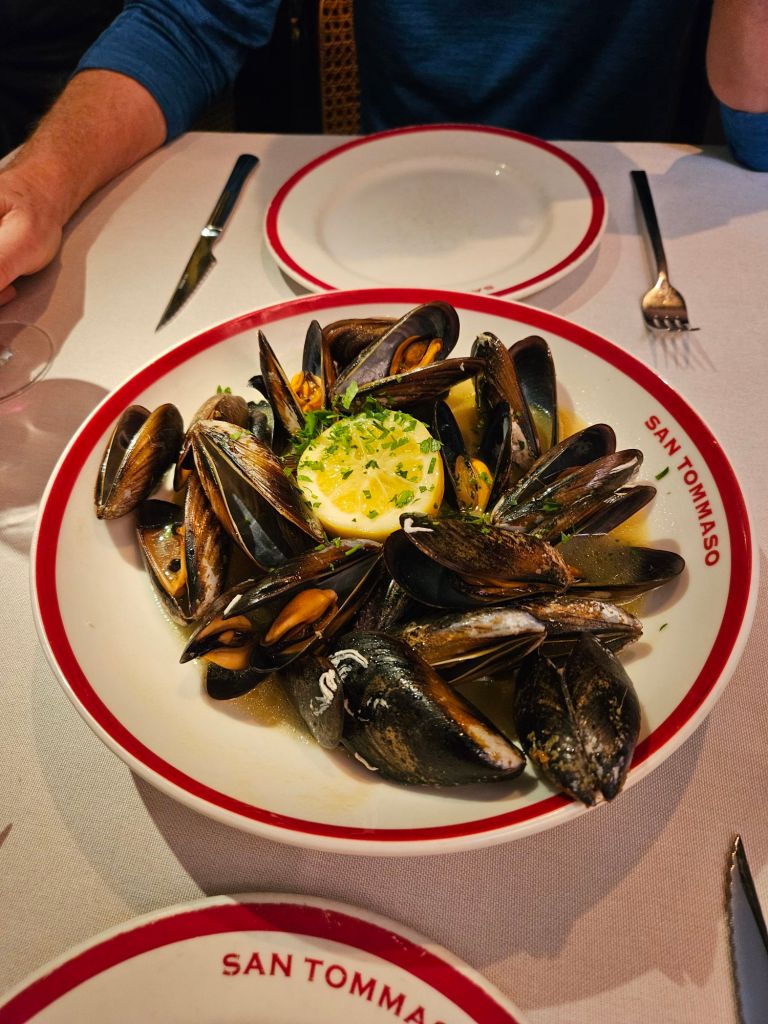
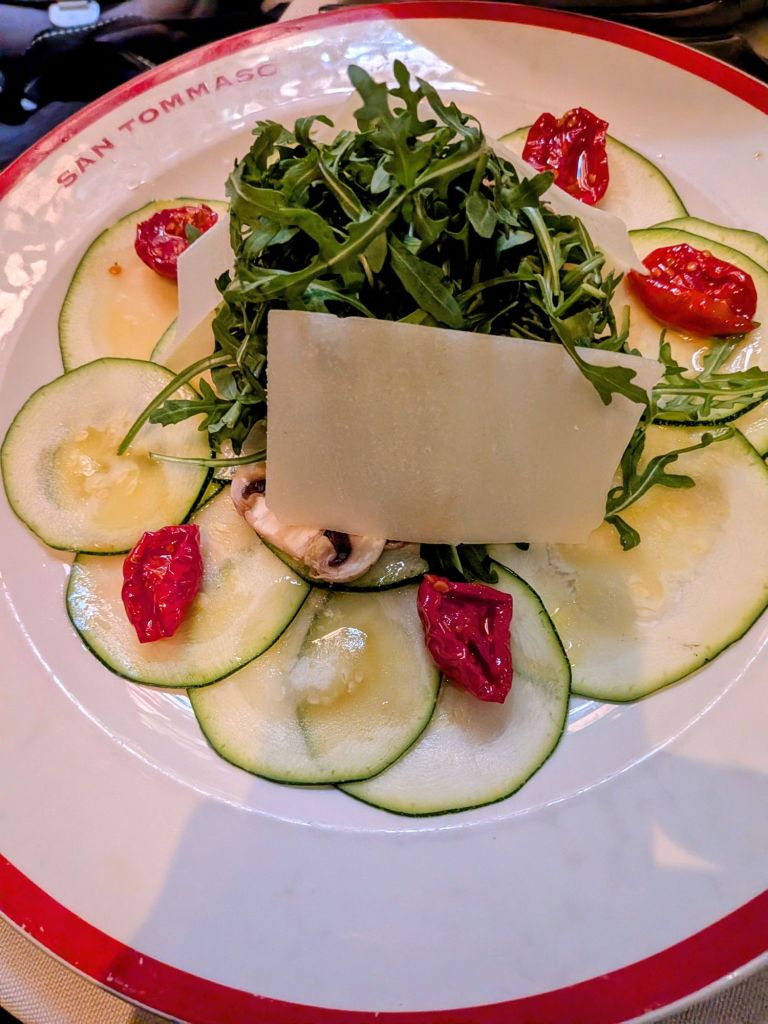
We started with mussels and a zucchini carpachio with thin shavings of parm, dollops of roasted tomato and a scattering of arugula.
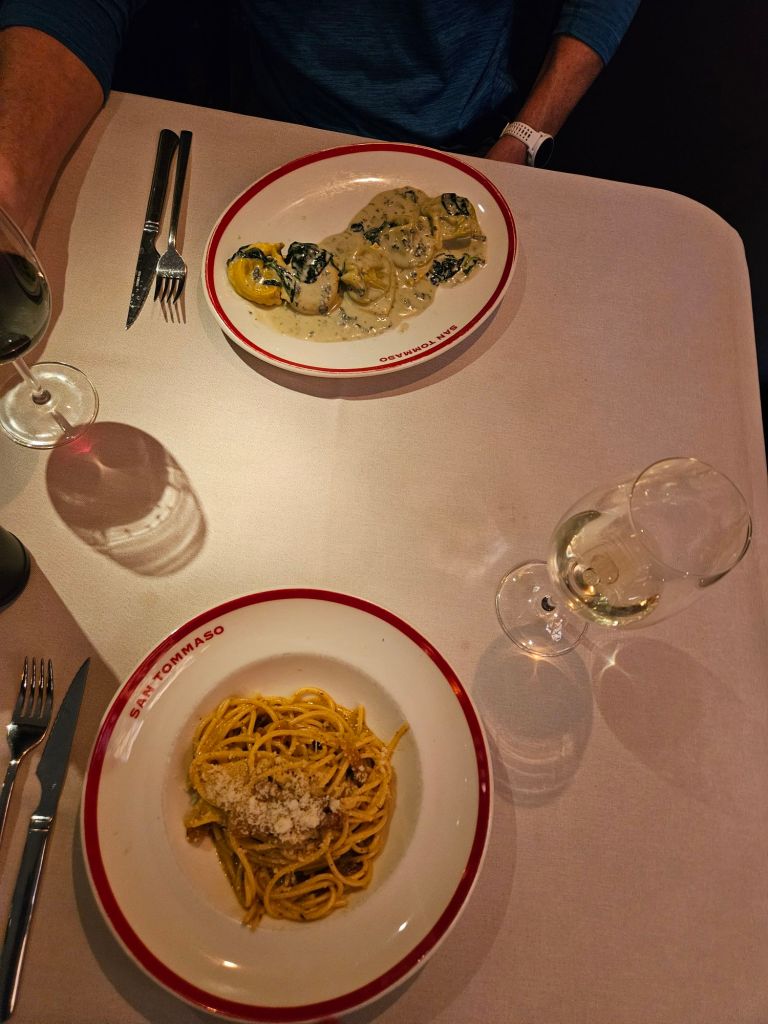
Followed this with pasta carbonara with truffles and tortello verde (spinach stuffed oversized tortellini with gorgonzola sauce).
Washed it all down with two generous glasses of wine each – Albariño for K and Tempranillo for R.
Finished “lunch” around 6pm and enjoyed our gentle walk home, floating about two inches above the park. Ahhh.
(For the record, I should note that we shared an apple around 9pm and called it dinner. It was enough.)
We were in the Museo de Bellas Artes, gawking at the incredible art, when we heard a crash. Turned in time to see another visitor, intent on crossing the room to see a painting more closely, flying over the low bench in the middle of the room.
(R here: I turned the corner into that room just in time to hear a crash and see a woman suspended improbably in mid-air above a stone bench, face towards the ceiling. It looked a bit like an action shot from a rugby match.)
Joan (whose name we later learned), hit the marble floor hard. Fortunately, she did not land either head first or with wrists extended. Not so fortunately, she gashed her shin and landed with all her body weight on her right shoulder.
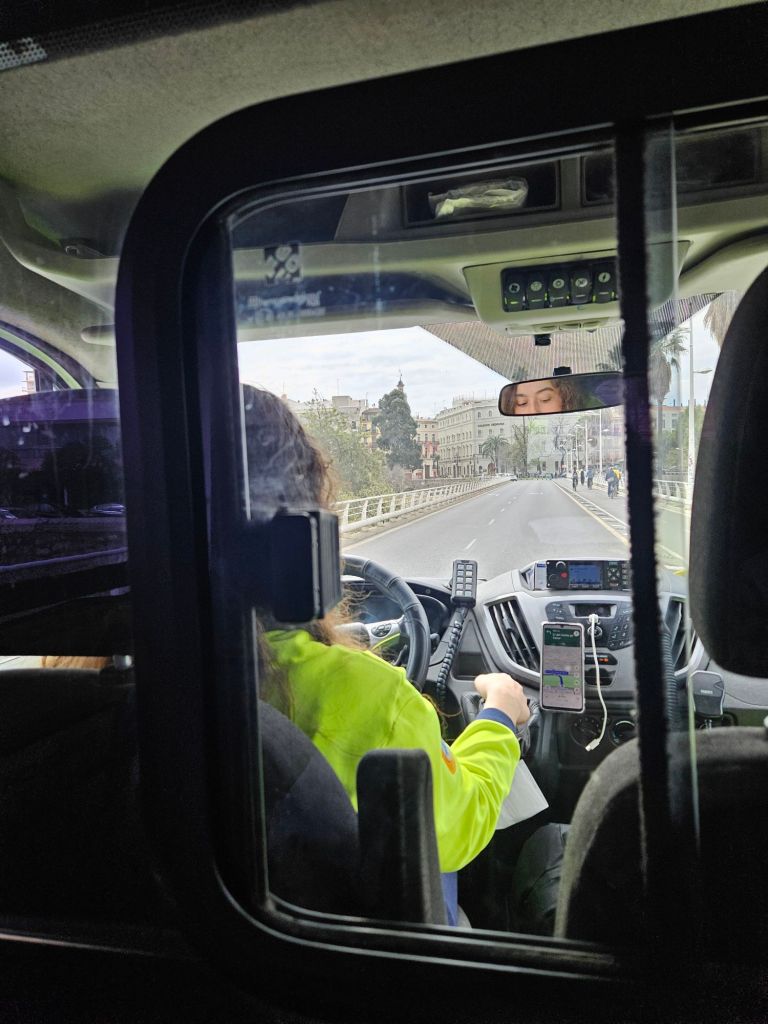
Using our best school Spanish, we were able to translate between Joan and the security guards. Ultimately the guards called an ambulance, but because Joan and her husband Eric didn’t have their travel insurance documents on them, I rode with Joan in the ambulance while R and Eric went back to their hotel to collect the papers.
The driver/medic spoke limited English, but between her English and my Spanish, we worked it all out. She was very patient and introduced me to a new Spanish phrase–con dos, somos uno. Roughly, with two, we make one. The local version of “it takes a village.”
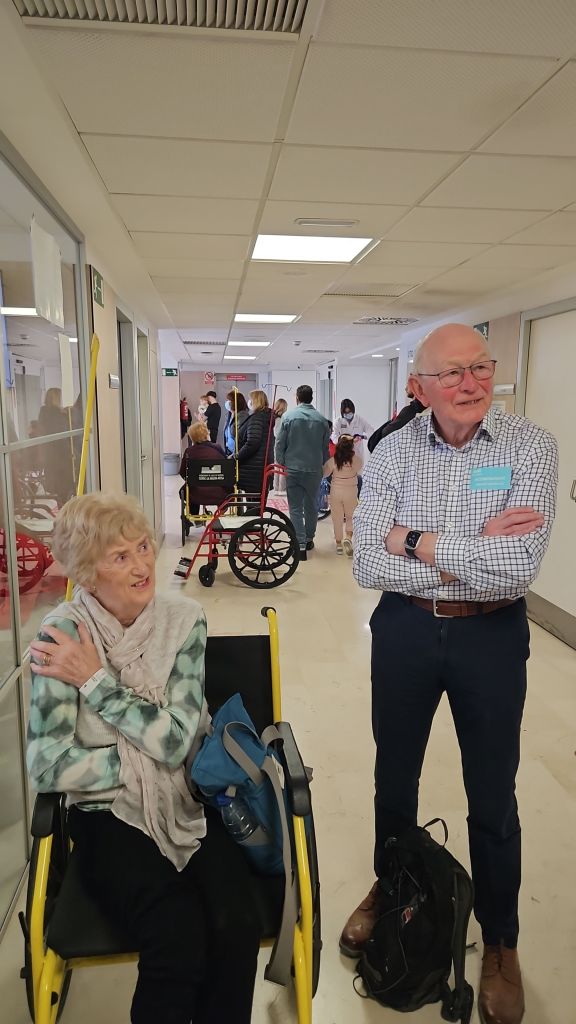
Joan and I arrived at the very crowded local hospital and got her checked in–super easy process. Eric and R arrived shortly thereafter, and we said our goodbyes after connecting them to the triage nurse who spoke English.
Joan later sent a picture of herself back at her hotel, sporting a spiffy new sling. Turns out she fractured her humeral head (top bit of the arm bone) and is not thrilled about losing her golf game for a while.
All in all, we were impressed with the system; the ambulance driver even made sure to pick a hospital that would be easy for R and Eric to get to from the hotel given the road closures for Las Fallas.
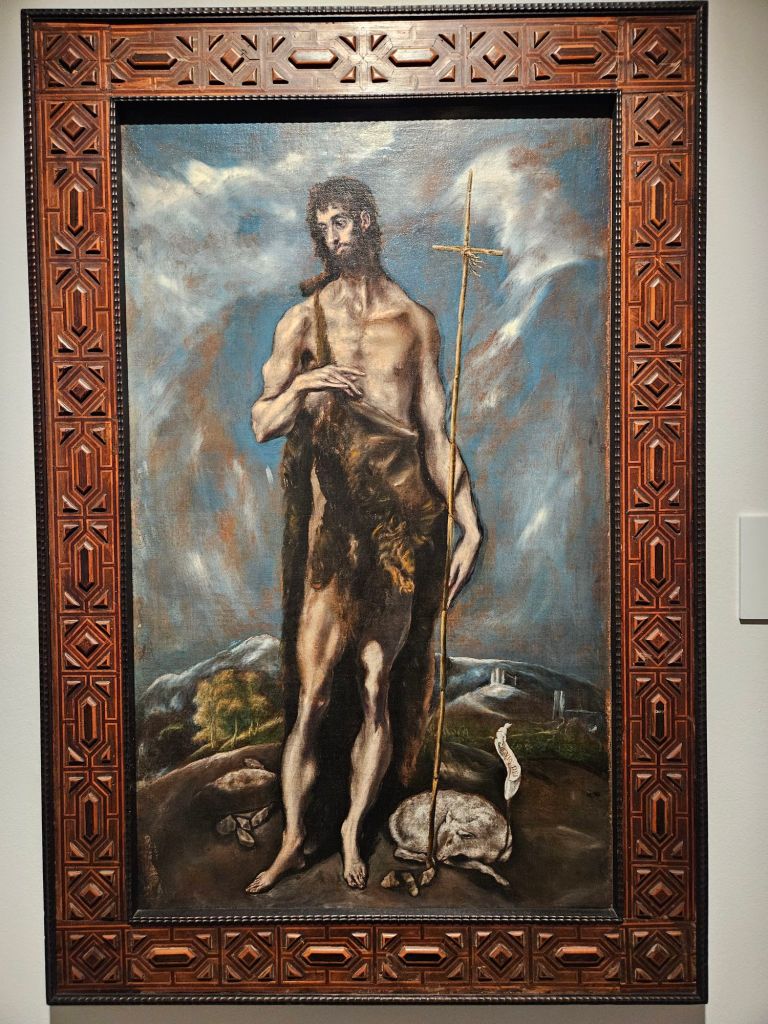
(R here again. Joan had managed to get within one room of the painting she really wanted to see, Juan Bautista by El Greco. K made sure later to go back and take a picture of it for her.)
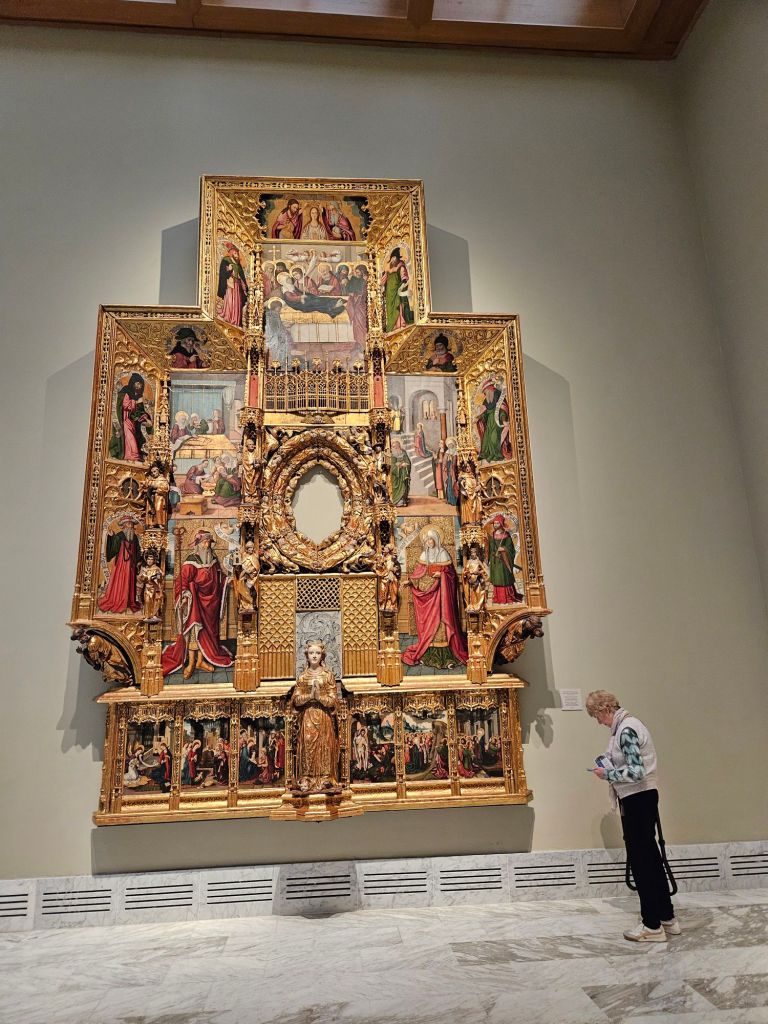
What with school and homework, we did very little by way of museums and sights in our first two weeks. But today it begins! After a simple brekkies at our hotel, we walked through the park to reach The Fine Arts Museum. Oh wow. (Already revisiting our perpetual travel need for more superlatives.)
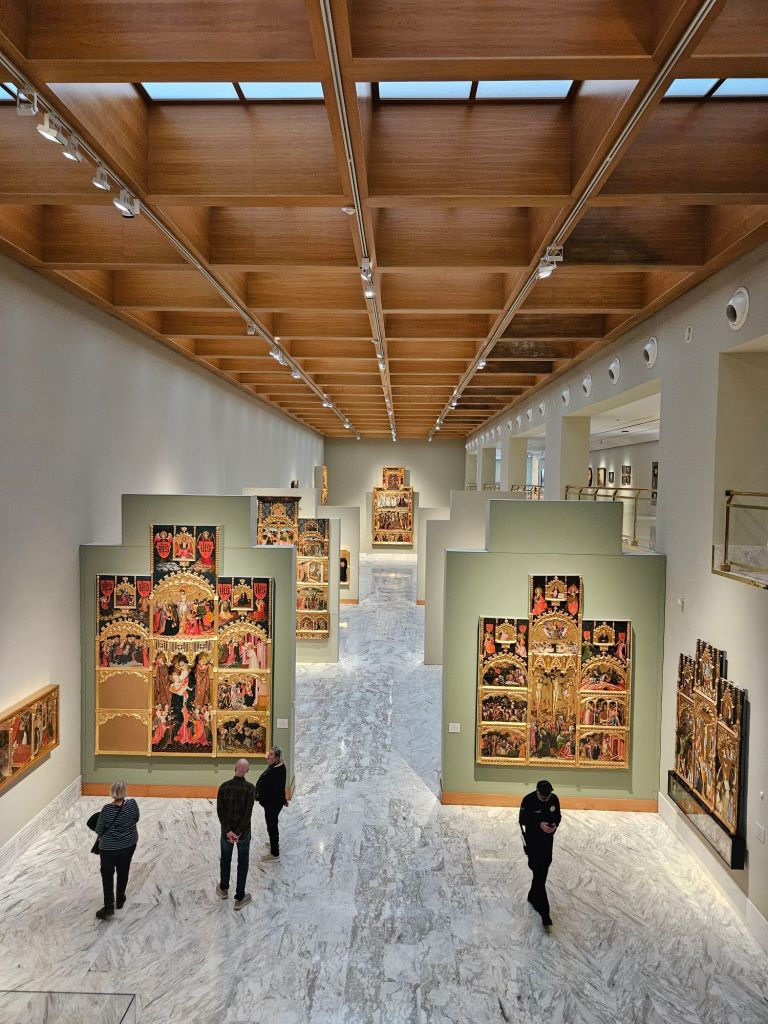
We started in the lower floor with the medieval stuff, thinking we’d give it a quick look before moving on to the Renaissance and upstairs to the 18th and 19th centuries. Little did we know how captivating their collection of altar pieces would be.
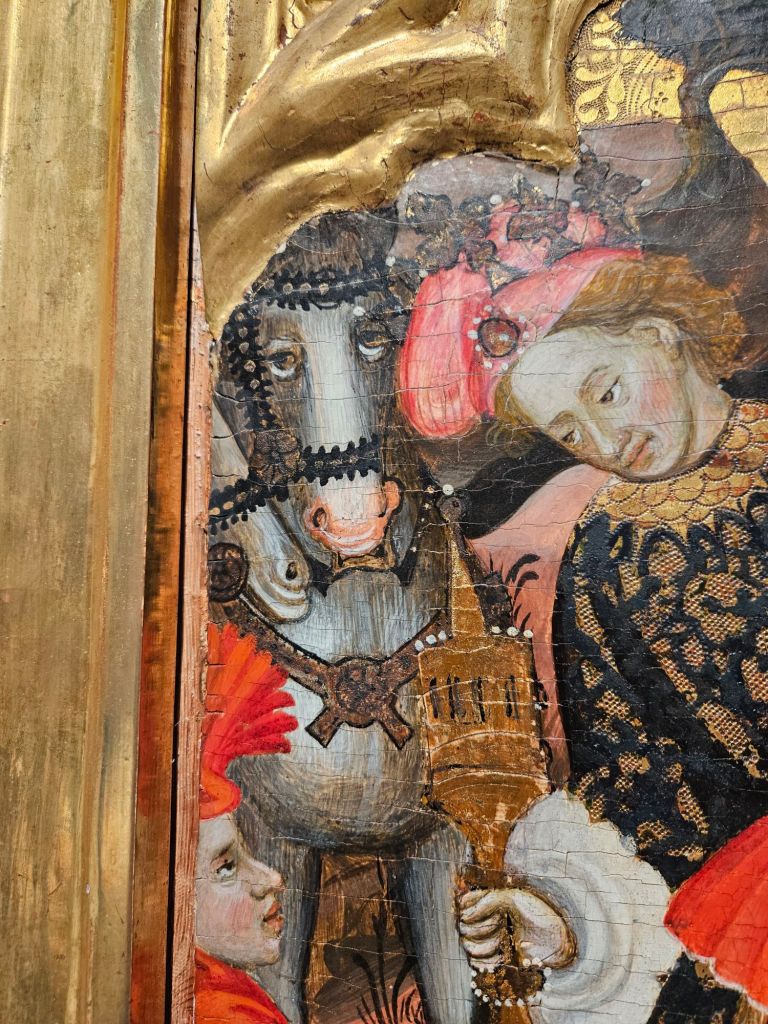
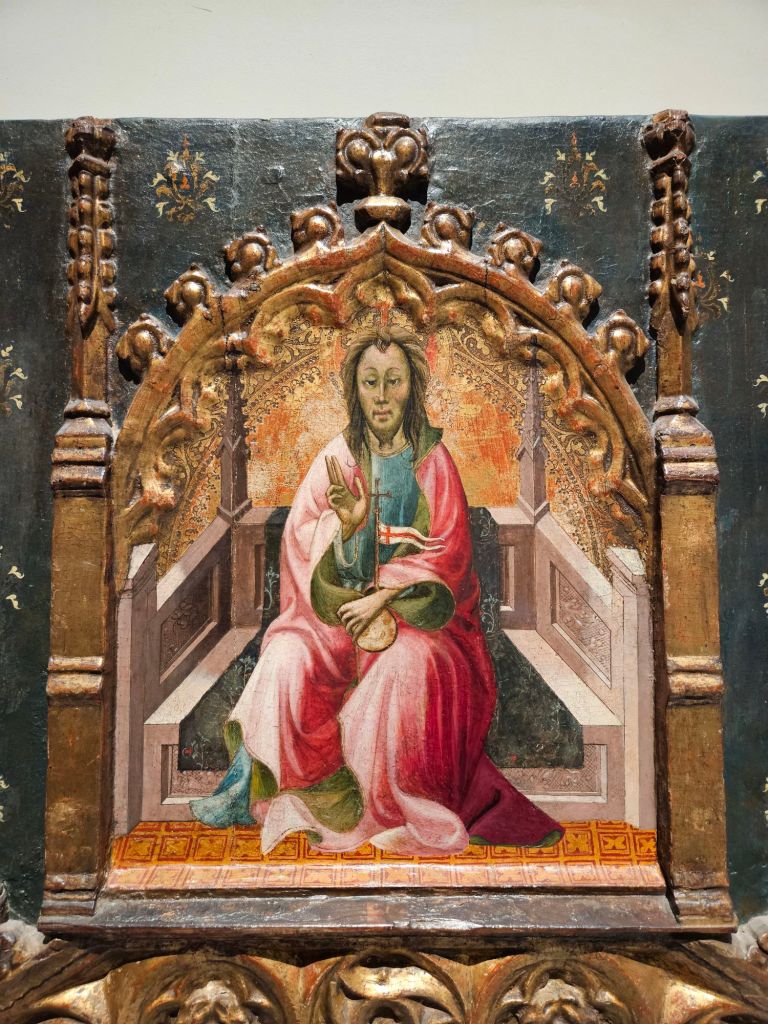
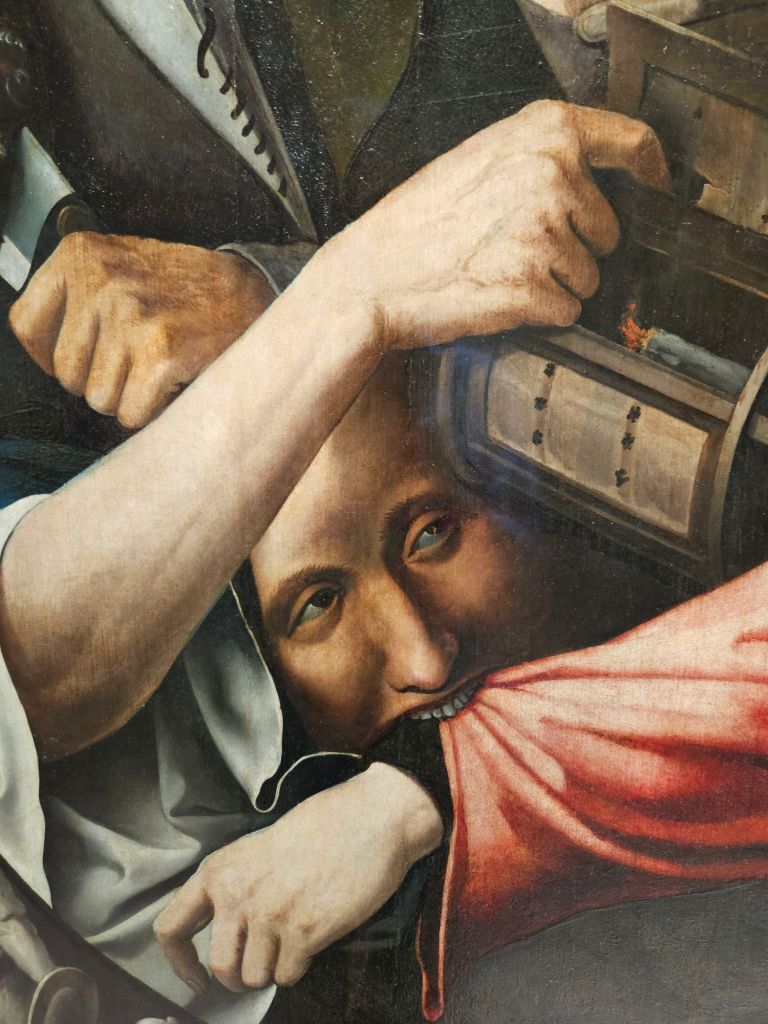
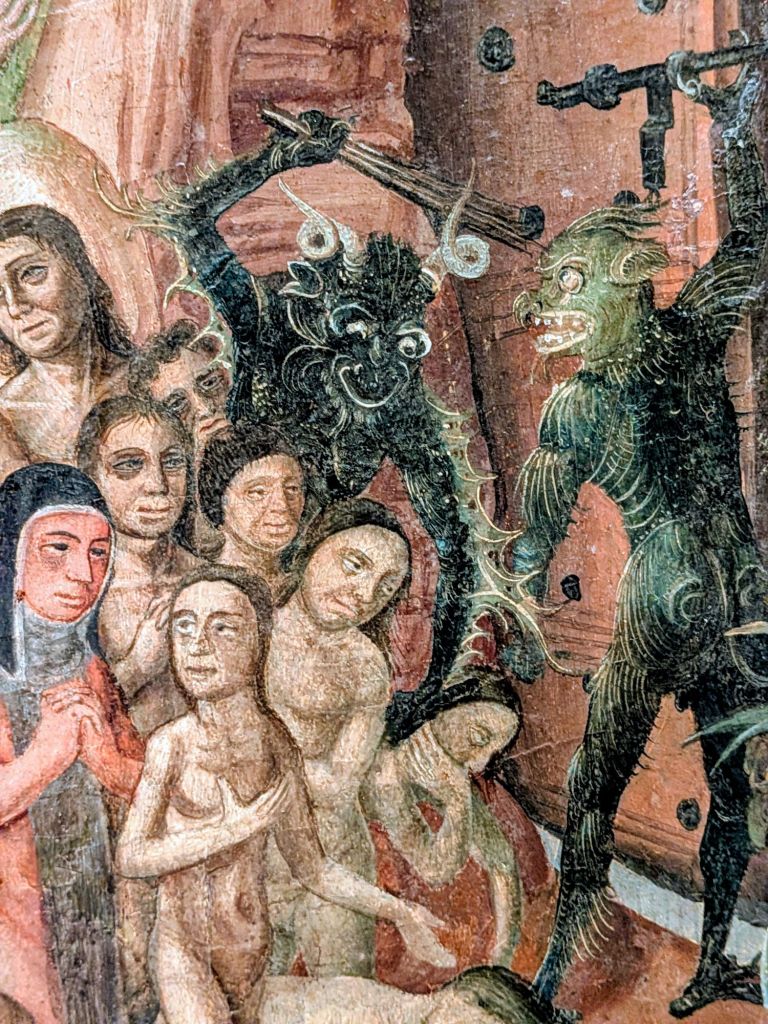
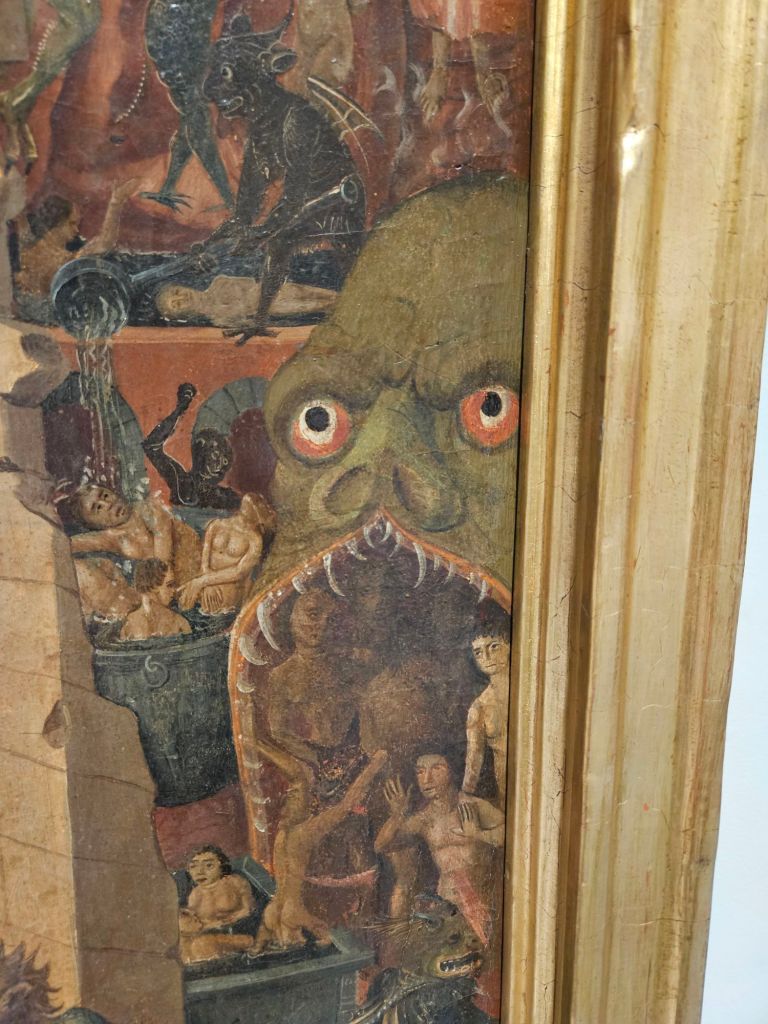
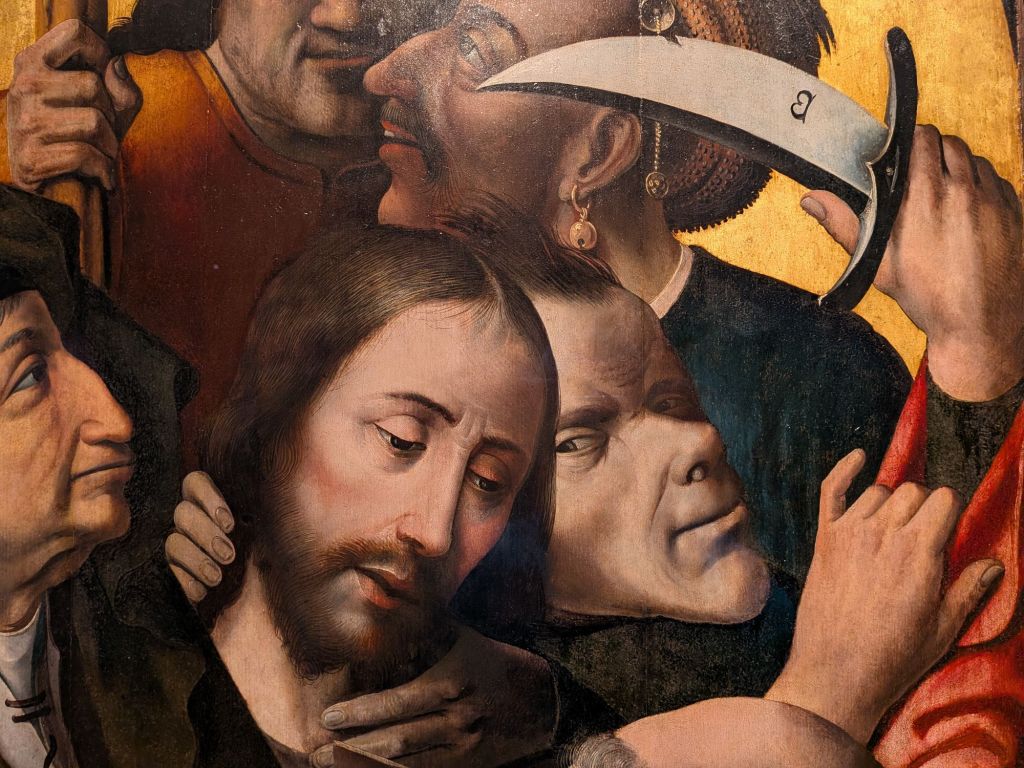
The scale of the altar pieces were incredible, but the details in the paintings really drew us in, especially the sly bits of humor in various expressions.
A bemused horseGod the Father a little tired – or stoned? Who knowsNot much fun, unless you’re a devil, at the entrance to Hell.An unpleasant hot tub experience Thug with knife wants to attack Christ. Needs to blow nose first.
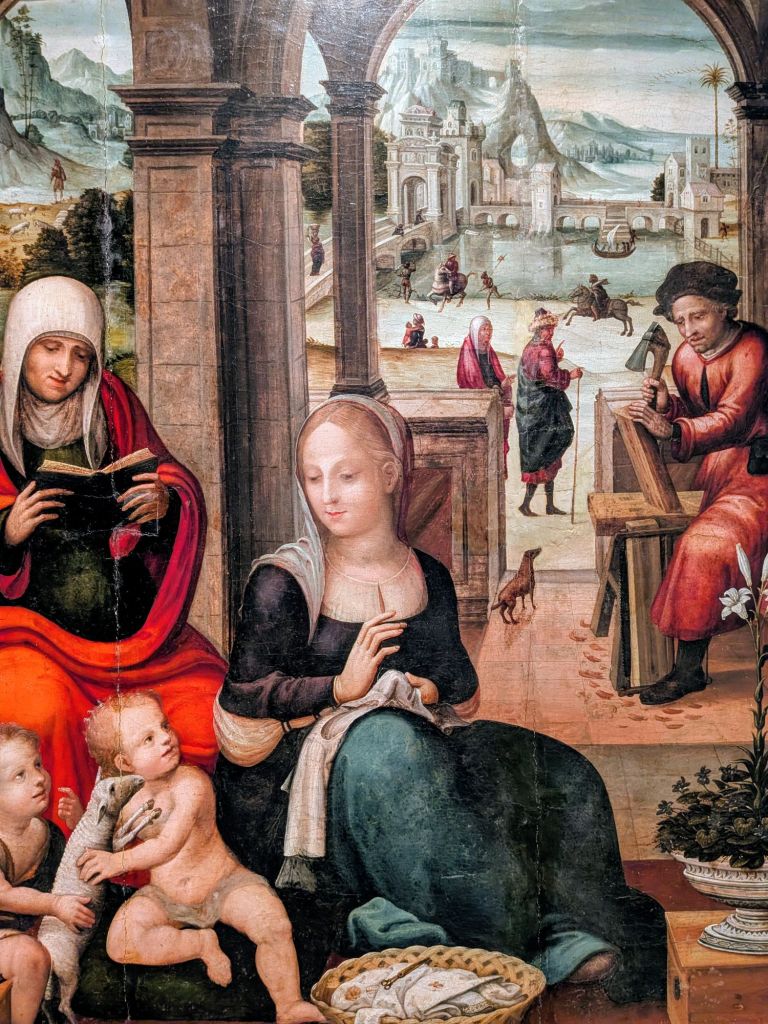
We had just moved on to the Early Renaissance – “Hey, everyone, I’ve discovered perspective!” –
Miguel Esteve, La Sagrada Familia, c. 1520
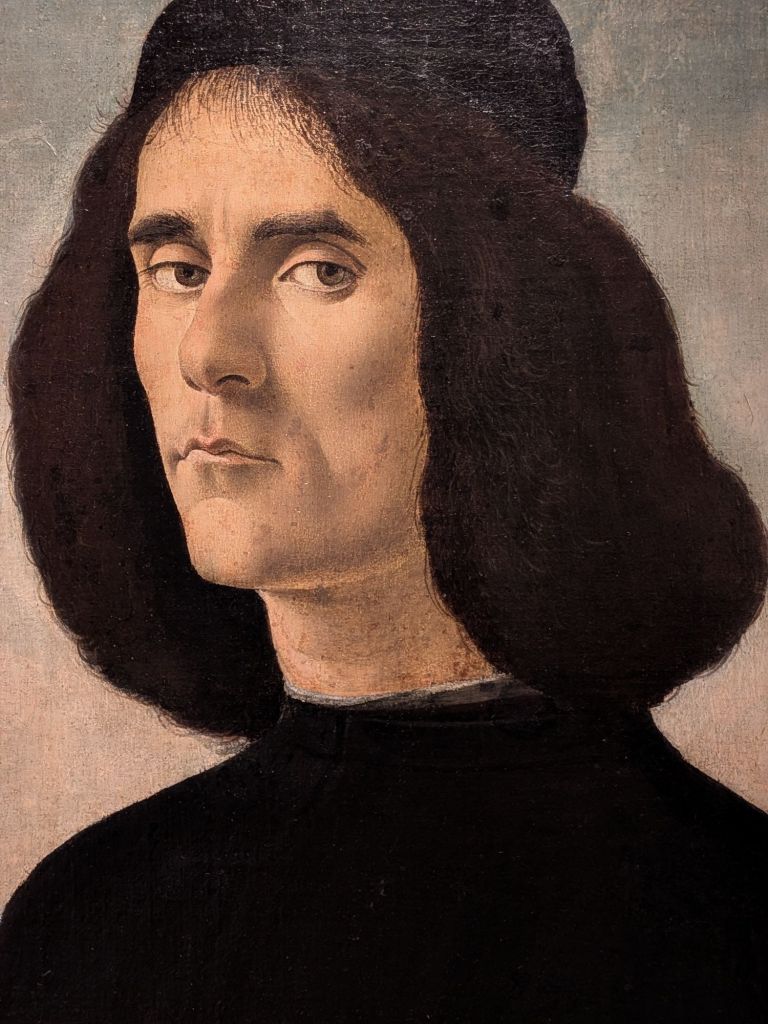
… and encountered Botticelli’s portrait of Mark Rylance in Wolf Hall –
(OK, I thought the resemblance was extraordinary, but possibly it was some Greek dude called Michele Tarcaiota) when…crash.
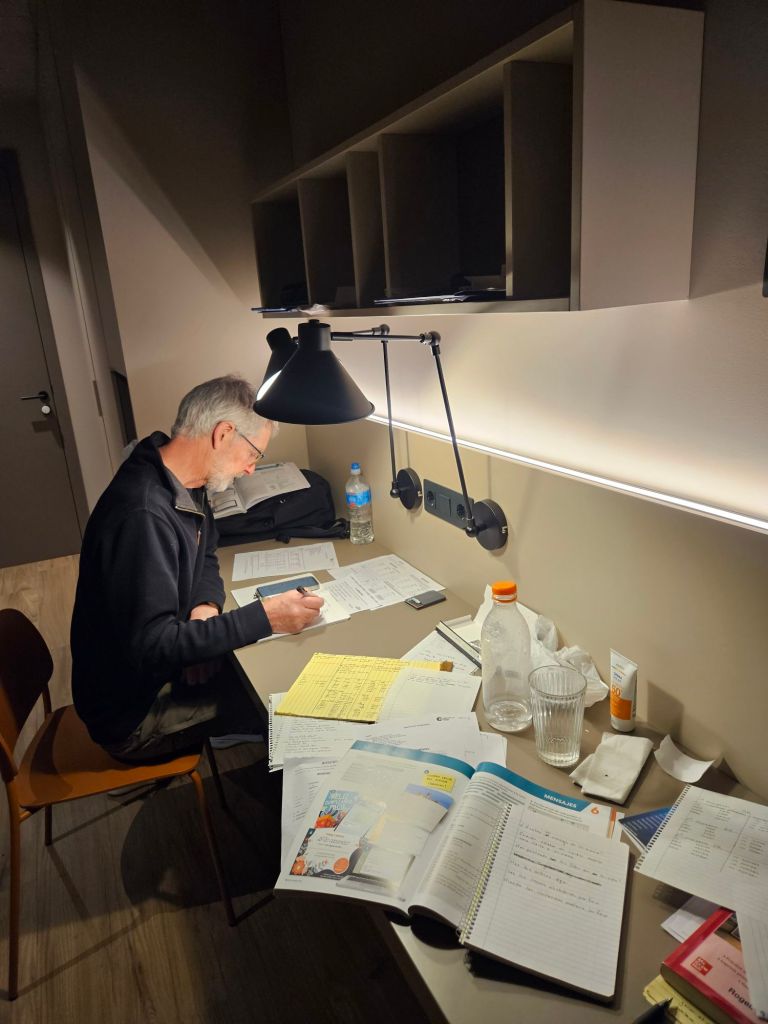
¡Haz tus deberes! (Hacer = to do, en el imperativo afirmativo = haz; deberes = homework)
Some years ago, Declan wrote a blog post in Vietnam describing a meal that pushed him to toss his cookies. After detailing some of the flavors, he added “and then my stomach said, too much information.”
I’m not sure what the mental equivalent of cookie tossing is, but I have definitely reached the “too much information” stage with school. I had just started to think that maybe I was making a bit of progress with the preterito imperativo vs the preterito indefindo, when our teachers merrily moved on to imperatives (both affirmative and negative)(which are, of course, conjugated differently from each other and have a ton of irregularities), and direct and indirect object pronouns.
 Kerry & Richard in Spain (mostly) 2026